Operational Impact and Response The Coca-Cola Company revealed a cyber incident impacting its Fairlife dairy business on July 16, 2026. The disruption forced an immediate nationwide pause on U.S. processing...
TSMC plans four more Arizona fabs, bringing its total US investment to $265 billion and expanding chip capacity amid surging AI demand and geopolitical risk.
TSMC plans four more Arizona fabs, bringing its total US investment to $265 billion and expanding chip capacity amid surging AI demand and geopolitical risk.
Like its U.S. counterpart, the European Chips Act aims to foster the semiconductor industry — in part thanks to state subsidies. One of the beneficiaries is QuantumDiamonds, a German startup that applies a novel approach to inspecting chips.
US manufacturers in many Rust Belt cities and towns are paying significantly higher electricity costs as growing energy demand from data centers strains the largest power grid operator in the United States. The resulting squeeze on profit margins for steelmakers and brick factories could further undermine President Donald Trump’s “Made in America” plan to revive US manufacturing, and it comes as Trump has simultaneously championed the tech companies behind the AI data center boom.
Factory electricity bills are generally rising faster than those for other business customers or residential customers, according to a Reuters analysis. It highlighted the example of the Belden Brick Company, a 141-year-old brick manufacturer in Ohio, whose electricity bills have soared from $1,600 to $12,000 per month due to a higher monthly capacity charge in the 13-state region served by the grid operator PJM Interconnection.
Meanwhile, the Steel Manufacturers Association warned that US steel companies concentrated in the Rust Belt region served by PJM Interconnection are paying tens of millions of dollars in higher power costs per year. Electricity accounts for 20 to 40 percent of the total production costs of making steel.
In the sweltering temperatures of an unusually hot European heatwave, I found myself having a chat with a friend of mine from my university days. After discussing the health of his cat who had solved the problem of a fur coat on a hot day by flattening himself out on the concrete floor in the coolest place in the house, we moved on to tech matters. We’ve known each other for not far short of four decades, so this is familiar territory for us. The problems that come with taking a prototype to manufacturing, a process which even the most seasoned of engineers can slip up on.
The Difference Between Making, And Making For Manufacture
If you’ve ever taken a project and replicated it, you will know the progression. If you’re making five or ten widgets, you can debug and rework as needed, tweak things, and get things going. If you’re making more then this, the process consumes a greater proportion of your time, until a point at which manufacture becomes impractical. Maybe that’s around fifty boards, sometimes more or less.
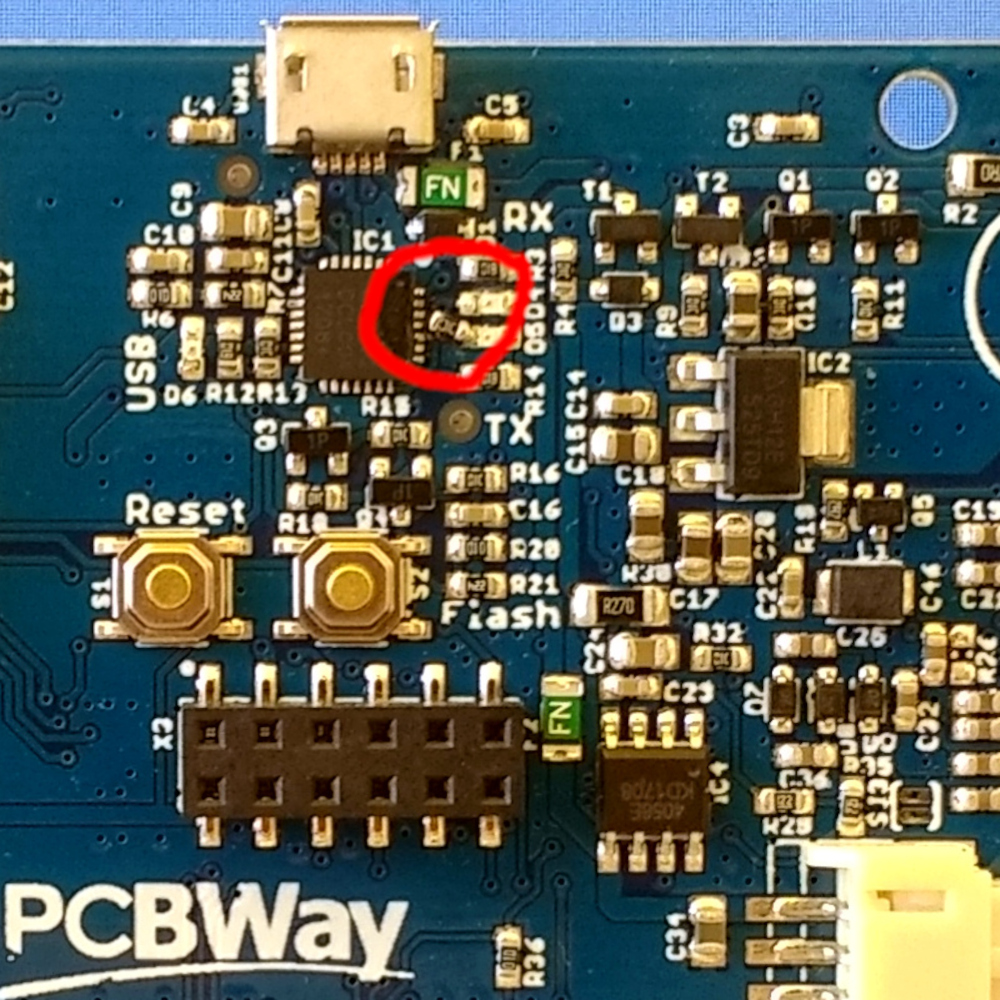
This rework on the SHA2017 badge was caused by counterfeit parts rather than bad design, but the work it created was very costly for the team.
The skill a professional engineer picks up here is designing for manufacture. It’s something I picked only progressively over the years, and learned with a bang when I became peripherally involved in the production of electronic conference badges. You learn to be much more exact in your PCB design to avoid those reworks and bodge wires, you pick your parts with much greater care, and pay far more attention to power supplies, decoupling, thermal issues, impedances, and ground isolation. Something that works has to become something that always works, first time. You go from having several spins of the prototype PCB to having maybe a couple, and you reach a point at which you can order 5000 boards and have less than 50 of them that need attention. My friend describes himself as more of a software expert than hardware, but he’s learned this process over the decades far more than I have.
One comment he made hit the mark so well that it prompted me to start writing this: that when hiring recent graduates they would design things that could not be volume manufactured, while the new hire apprentices’ designs could. This fit so well with our common experience when we came through an engineering education that it posed the question, were we failed by it? We both attended the University of Hull, on England’s north-east coast, but this isn’t specific to Hull or even our generation as the problem of inadequate preparation applies to so many other institutions. Last year I talked about a couple of young engineers wrestling with an analagous experience here in the 2020s, and they were a long way from the Humber.
Do Universities Secretly See Their Job As Training More Academics?
Hull University Electronic Engineering Department, where I learned most of what I know about electronics (except how to make things for manufacture). Hullian111, CC BY-SA 4.0.
My overwhelming memory of my degree course was shared by my friend, that about half of it was composed of useful stuff, and the other half of it was either trying to teach you to be an electronic engineering academic like the people delivering the lectures, or a course that seemed only to be there because they had someone who could teach it.
My Achilies’ heel was the mathematics, something I was later told improved in later years when the engineering department wrested its students away from the maths department. We had a very small amount of practical work, including simple transistor circuits, digital logic using real 74-series chips, laying out a PCB using crêpe paper tape on acetate film, and oddly considering it was outdated even in the early 1990s, wire-wrapping.
It’s easy to sit here and say that a university course teaches too much theory and not enough practice, but the fact is that universities aren’t there to teach you to solder. Indeed, while it’s a super-useful thing to be able to do and I’d urge every electronic engineer to learn it, soldering your own projects is not what makes you an engineer. Instead there has to be an exploration of where the boundary lies between the theoretical and the practical, and education should straddle that line rather than stay only on one side of it. It’s in deciding where that straddling point stops that the key lies.
There are university courses that manage that boundary by splitting it entirely. They combine time in industry with time studying, and a student on one of those courses would in theory learn the skills of a real-world engineer in their work placements. There are also industry sponsorship schemes placing students into industrial environments, but they are so few and the competition for them so fierce, that they might as well not exist for most students. Even the world of hackerspaces which gives the students a rare chance to mix with professional engineers in their off-time, is actively discouraged by universities. For a student in a full-time, study-based course, the challenge comes in how to bridge that gap into real-world manufacturing despite all these challenges, and learn something useful without the luxury of a real-world environment.
Torturing The Students With Diabolical Designs
The temptation for most courses is to start yet another group project. A team of six students are tasked with getting something working together, and learn stuff. The trouble with group projects though is that they either completely don’t work like our early 1990s assignment to make a telephone exchange from a Transputer link adapter chip, or a few participants end up doing all the hard work like my two young friends mentioned earlier. Group projects are inexpensive for an institution, but they look better than they really are.
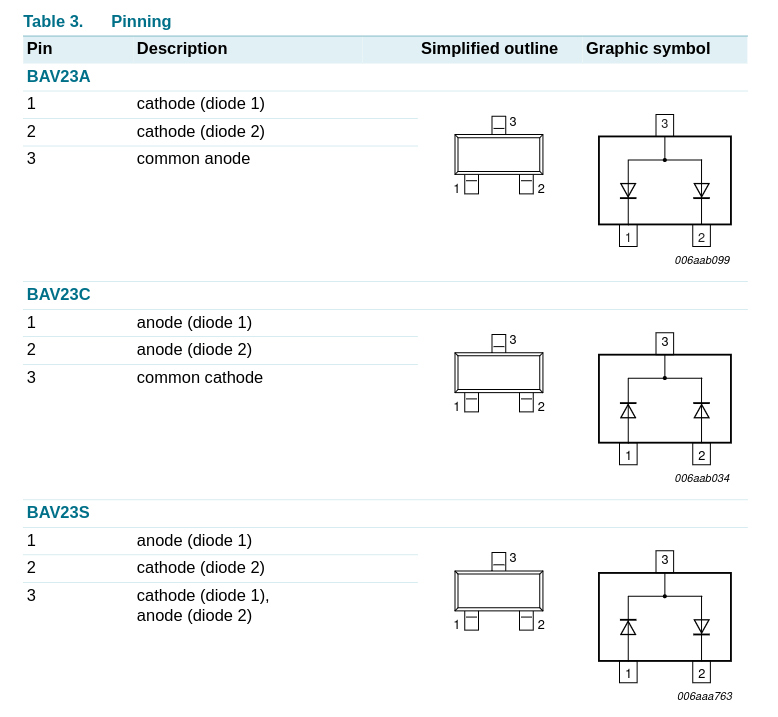
Component pinouts like this one from the NXP BAV23 datasheet are a spectacularly evil trick to play on an unsuspecting student.
The hardware hacker world has been marked by a series of epochs, as new technologies bring with them a flowering of creativity. There’s one of those that I think has the potential to delover something impossible back in the 1990s when I was a student, and allow individual students to learn the art of manufacture without a group project in sight. I’m talking about inexpensive PCB manufacture, which allows multiple spins of a design to be completed with a bearable wait, and for not a lot of money.
So if I wanted to teach a bunch of students about designing for manufacture, I’d give them a ready made small project in software form, as EDA files, and as a BOM with a board assembly house. Of course, the project would be fatally flawed but fixable with probably two or maybe three spins, but I wouldn’t tell them that. Instead their first task would be to send the files off and receive a ready-made PCB, or if I was feeling charitable I could give them that first spin ready-made, and tell them to get on with it.
I would throw everything I could at this unfortunate design, a wrong-but-plausible footprint, badly thought out earthing, an accidental oscillator, and all the really annoying things which we’ve all in our time found. I am sure you could think of more diabolical but superficially plausible features. Their task would involve diagnosing the board and redesigning it before sending the files off to the assembly house. A week later they’d have that next spin, they’d have to hunt down any remaining bugs and repeat it all, and so on. I learned this process with my friends in the making of an event badge for 5,000 people, and I think it’s possible that you could learn it as a single trainee engineer with a much smaller board.
It may be unfair to throw all that is wrong with engineering education at the door of universities, even though it’s certain that there are some extremely low hanging fruit. But arriving in the workplace completely lacking an essential skill is perhaps the point at which something should be said. The question is, when it comes to designing for manufacture, is anyone listening?
To varying degrees, each form of motorsport combines sport, entertainment, and technological development. As Ars has explored, there are valuable lessons that companies can learn from competition, particularly when the pressure is as intense as Formula 1. If you asked me last month, I would likely have said that when it comes to historic racing, it's almost all about the sport and entertainment, with precious little tech development.
But that was before I spoke with Matt Faulks, executive innovation director at Lola Cars, about the company's new run of T70s. The original T70 debuted in 1965, and Lola built more than 100, which in the latter half of the 1960s proved effective in short races like the Can-Am series as well as endurance events like Le Mans or Daytona. Latterly, T70s have proved popular among the historic racing crowd, and as Lola rebuilds itself after being saved in 2022, it's joining some of the other storied manufacturers by digging into its archive. Lola will have 16 new cars, configured either for historic racing complete with the necessary FIA homologation papers as the T70S, or as a UK road-legal version, the T70S GT.
But it's the use of materials that makes the new T70S particularly interesting.
This is the final article of our Drone Warfare series on Ukraine’s rise as a drone powerhouse. But Ukraine’s success story is not one it achieved alone. The country’s drone industry was built with the support of partners from around the world who helped Ukraine during its most difficult times. Here we look at Ukraine’s export strategy and how it can serve as a way to give back by sharing hard-earned battlefield experience and technology with the nations that helped make this success possible.
Battlefield Experience
For most of the war, Ukraine’s drone sector existed on the demand side of the defense market. The country needed huge volumes of FPV drones, interceptor drones and reconnaissance systems simply to keep pace with the battlefield. By 2026, that position began to change. Ukraine started to present itself not only as a state that needed drones, but as a state that could supply them, co-produce them, and teach others how to use them. In March 2026 President Volodymyr Zelenskiy discussed joint arms production with Dutch Prime Minister Rob Jetten and said Ukraine was ready to export interceptor drones that are not needed on its own battlefield.
Interceptor drones and the latest AI developments. Source: Ukraine’s Arm Monitor
Ukraine is not trying to sell a platform developed in peacetime and polished for foreign buyers. It is offering weapons and systems that were shaped by daily combat against a technologically capable enemy. That gives Ukrainian exports a different value proposition. They are presented as battlefield-tested tools that have already survived the hardest possible proving ground.
The Export Model
Ukraine’s export strategy depends on the fact that it is producing more than it can immediately absorb on the front line in certain categories, especially interceptor drones. In June 2026 Ukraine said it could produce 2,000 interceptor drones per day, with about half potentially available beyond domestic needs, and that it could supply at least 1,000 interceptor drones a day to allies facing Shahed attacks if investment improves. That is the logic behind the export conversation. Ukraine is not opening the floodgates on every weapon it makes. It is identifying categories where production has moved beyond immediate domestic consumption.
Business Insider also reported that Ukraine wants to protect its own security first and only share technologies that do not compromise its battlefield position. That means exports are likely to focus on systems that are already partially superseded on the Ukrainian front, or on systems that can be co-produced under controlled conditions.
Europe
Europe is the most obvious destination for Ukraine’s export strategy because the continent is already moving in Ukraine’s direction. The Netherlands are going to spend €248 million on drones for Ukraine, with production split between the Netherlands and Ukraine. On 17 June 2026 the Netherlands pledged another €500 million for drones and air defense equipment. These are signs that European governments are beginning to fund drone production as an industrial activity.
The Drone Squad Fury unmanned aerial platform developed by OM Defense Systems on display at the Eurosatory defense exhibition in Paris, June 2026. Source: Militarnyi
The broader European defense picture points the same way. It was reported that G7 countries and the United States had agreed to allow Ukraine-based and European firms to produce long-range missiles and air defense systems under license. Europe is no longer only buying Ukrainian results, it wants to buy into the production model behind them.
Source: Airbus’ drone portfolio
The broader European defense market is also moving in Ukraine’s direction. For instance, Airbus partnered with the French counter-drone startup Alta Ares. Under the June 2026 memorandum of understanding, Airbus will integrate Alta Ares’ AI-guided interceptors, including the Black Bird and X-Lock systems, both combat-tested in Ukraine since 2024, into its Fortion IBMS command-and-control platform, connecting Alta Ares’ targeting software and interceptor drones to Airbus’ battle management systems to create a sensor-to-shooter chain against drone and cruise missile threats.
Middle East
The Middle East is the second major market because it faces a different but equally urgent drone threat. In March 2026 Zelenskiy said Ukraine was ready to send instructors to the Middle East and export interceptor drones that are not needed at home. Business Insider added that Ukrainian officials see older Ukrainian counter-drone technology as still useful for allies facing Shahed attacks, even if those systems are already outdated by Ukraine’s own battlefield standards. A weapon does not need to be the newest model to be valuable if the user’s threat environment is less intense than Ukraine’s.
Ukrainian interceptor drone in open terrain (desert-like background works well for the Middle East angle)
That makes the Middle East a natural fit for Ukraine’s export model because the buyer often wants a system, not just a drone. The package includes interceptor drones, training, radar integration, and electronic warfare resilience. Zelenskiy explicitly framed the issue that way, saying that without radar coverage and software that can operate under jamming, an interceptor is not a real defender.
Production
The most interesting part of Ukraine’s export strategy is not the sale itself. It is the move toward co-production. The point of co-production is to make exports more durable and less vulnerable to disruption. It also lets allies develop industrial capacity while Ukraine keeps access to the newest combat-tested designs. The G7 agreement reported by The Guardian shows a model where production can be shifted into partner territory while still drawing on Ukrainian experience and requirements. That approach helps solve three problems at once. It spreads risk away from the battlefield. It makes procurement faster for partners. And it creates a legal framework for sharing sensitive technology without handing over full control of the most advanced systems.
The Financial Logic
The export strategy also has a budget logic. Drone exports and co-production can help bring in foreign money, expand industrial capacity, and reduce pressure on the domestic defense budget. The Netherlands’ funding would support drones and air defense equipment for Ukraine, while Ukraine’s officials see export volume as a way to unlock more production capacity. The practical idea is that external orders help keep factories busy, while revenue and investment help scale the next generation of systems.
Ukraine’s Drone Industry arrives in Düsseldorf. Source: DroneXL
This logic is important in wartime because the domestic state cannot fund every possible expansion on its own. Exports make production more sustainable. They also let Ukraine distribute risk across several partners rather than relying only on its own budget and wartime aid flows. In other words, the export strategy is partly about money, but it is also about industrial resilience.
Main Constraints
Ukraine’s export strategy is still tightly constrained by its own security needs. Ukrainian officials want to keep priority for domestic forces and treat exports as selective. That means the country is not trying to become a free-market weapons bazaar in the middle of a war. It is trying to manage surplus capacity without weakening the front line. There is also the issue of sensitivity. Not every system can be exported, and not every partner can receive the same level of access. Licensed production in allied countries solves part of that problem, but only part. The more advanced the system, the more likely it is to remain under stricter Ukrainian control. That is why the export strategy is likely to be layered. That means some hardware is going to be sold directly, while some systems will be co-produced, some software and training will be shared for integration, and some capabilities will stay in-house.
Strategic Value
Ukraine’s biggest advantage in the export market is not price alone. It is combat credibility. Allies are interested because Ukraine’s drones and counter-drone systems were developed in the harshest possible environment. A state that has spent years fighting under heavy electronic warfare pressure, missile strikes, and mass drone attacks has something to offer that many peacetime defense industries do not. That does not mean Ukraine will dominate global drone exports. Competition is still strong, and certification with production security all remain real obstacles. But the country has already crossed an important threshold, where it’s no longer only asking for help. It is now a partner that can supply systems, share production, and train others to fight the same kind of war.
Conclusion
Europe wants production. The Middle East wants interception. Ukraine wants revenue and industrial depth. That creates a new model built around selective exports and battlefield-tested expertise. Ukraine is no longer only defending itself with drones, but it is using drone expertise to build alliances. That is the meaning of its export strategy today.
FILE -A steel worker moves a 155 mm M795 artillery projectile during the manufacturing process at the Scranton Army Ammunition Plant in Scranton, Pa., Thursday, April 13, 2023. The Pentagon could get weapons moving to Ukraine within days if Congress passes a long-delayed aid bill. That's because it has a network of storage sites in the U.S. and Europe that already hold the ammunition and air defense components that Kyiv desperately needs. The House approved $61 billion in funding for the war-torn country Saturday, April 20, 2024. (AP Photo/Matt Rourke, File)

 Login
Login