❌

Normal view

There are new articles available, click to refresh the page.
Today — 29 October 2026Main stream

2026 Retrocomputing Challenge: Custom RISC-V Processor For Retro System

29 October 2026 at 01:00

Although once little more than an academic endeavor, the RISC-V architecture is slowly supplanting applications that would have normally gone to ARM. Even a few microcontrollers have chips running this open-source instruction set now, and we expect it to grow in the future since it doesn’t require the licensing of an ARM or x86 chip. [M_Jagadeesh97] is getting ahead of the curve with this retro gaming system built on a custom-designed RISC-V system.

Most of us, presumably including [M_Jagadeesh97], don’t have access to chip fabrication tools, but what we can get is any of various FPGAs. This RISC-V CPU is built on a Terasic DE0-Nano board with 32 MB of RAM available to it, and boots to a launcher with 32 games available. There are a few limitations with this low-power system which was largely solved by limiting the display to 64×32, which lets it maintain the same aspect ratio as the original DOOM as well as the same aspect ratio for many of the older games, while still maintaining 45 FPS.

The project writeup goes deep into the design of a system like this, from the bare metal, the CPU design, the timing of the video signals, and how to implement a Wolfenstein-like raycaster. After adding a small display it looks to be fairly portable as well and is an excellent demonstration of how powerful inexpensive boards like this  FPGA can be with the proper amount of effort.
2026 Hackaday Retrocomputing Contest
Yesterday — 28 October 2026Main stream

Hacking the Modern Tamagotchi With UART

28 October 2026 at 19:00

Although not technically the first virtual pet, the Tamagotchi handhelds certainly popularized the idea and made it a worldwide phenomenon. In the late 90s it was hard to go out in public and not see them dangling from backpacks and belt loops. They turned out to be more than a passing fad, too. There have been Tamagotchis in various forms since then, and one of the latest, the Tamagotchi Paradise, is uniquely hackable thanks to this custom UART interface.

The build starts with a simple and inexpensive CH340G UART adapter with a built-in USB interface. A custom 3D printed enclosure is used to house the adapter and also help to expose the interface to the Tamagotchi. This is done by wiring three pins to nickel strips, which are threaded through slits in the case and looped back around to create a pogo-style adapter for the Tamagotchi’s custom dock. Normally this would be used to link to other Tamagotchis, but in this case the USB-to-UART adapter mimics it, allowing for all kinds of in-game shenanigans. The project’s creator [Squalius] shows it off by connecting it directly to a browser tool in Google Chrome.

Not only that, but this can also be used to modify the software running on the handheld entirely, with the video showing demos playing not only Super Mario but also DOOM (of course). This isn’t too surprising given that these games are built with modern 32-bit ARM microcontrollers. For the 90s purists, though, it probably won’t surprise anyone to know that these devices have been the subject of various hacks almost since they came out.

Before yesterdayMain stream

DOOM Ported to a $30 Clamp Meter

23 October 2026 at 04:00

DOOM. Boil it, mash it, stick it in a stew, it’s the game that runs on anything and everything. Now, the classic shooter is running on a rather unlikely target—a cheap clamp meter of very limited resources, thanks to the work of [Artur Bieniek].

The clamp meter in question is the FNIRSI DMC-100, which can be had for the low price of just $30 or so if you know where to look. It’s a far cry from the many thousands of dollars you’d pay for a heavy old 486-based machine back in 1993. [Artur] got the doomgeneric engine running on the Artery AT32F415 chip that runs the clamp meter.

The chip is pretty capable, with its 150 MHz clock speed, though the 32 KB of RAM posed rather a big limitation to the project. It may be one of the lowest RAM DOOM ports out there. Even with this limit, [Artur] was able to get Episode 1 of Freedoom: Phase 1 loaded on to the thing, including E1M1 to E1M9 along with the title screen, intermissions, the finale, the menu, and four save slots. Color graphics are displayed on the meter’s 320 x 240 screen, and there are even sound effects on the built-in buzzer. Controls are mapped to the rather curious choice of a DJI RC-N1 drone controller.

We’ve seen DOOM running on everything from desk phones to completely custom CPUs. These days you have to try pretty hard to find something it hasn’t already been ported to.

Clotty The Custom Period Tracker Can, Of Course, Run DOOM

21 October 2026 at 07:00

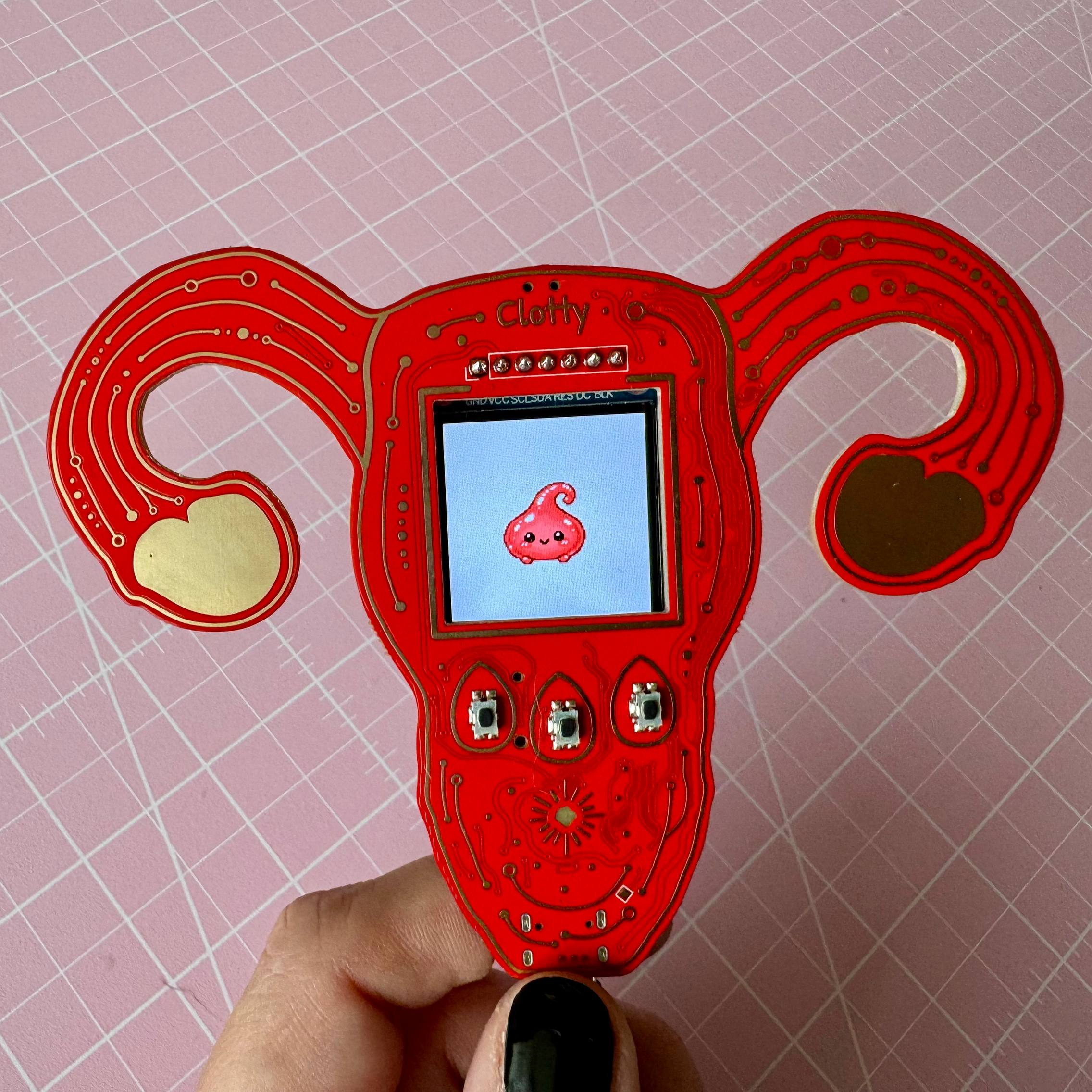
[kati]’s Clotty might run DOOM and game-ify the menstrual tracking process with a playful Tamagotchi-like aspect, but don’t let that distract you. It is, at its heart, a personal menstrual cycle tracking device that is defined as much by what it does do as what it doesn’t.

Clotty brings a Tamagotchi-like playfulness to the table.

What doesn’t it do? Well, it will never quietly upload one’s menstrual tracking data to a remote server. Nor will it harvest, mishandle, disclose, or sell that same data. Shamefully, that alone sets it far apart from the wide range of period tracking services and apps out there. Also setting it apart is its cheerful lack of discretion. As [kati] puts it, she wanted Clotty’s design to scream “HELLO I AM A PERIOD TRACKING DEVICE” and at this she absolutely succeeded.

Clotty uses an RP2040, color LCD display, and a small variety of sensors built into a palm-sized, uterus-shaped PCB complete with touchpad ovaries. Right now it’s still in its early stages, and basically at the point that everything works hardware-wise and the essentials are there for software, but it’s still in active development. Keep an eye on Clotty’s GitHub repository for updates as features get fleshed out.

Of course, as [kati] observes, the core validity of a device can be defined by whether it can run DOOM, which of course Clotty can. You can find [kati]’s fork of RP2040-DOOM here.

[kati] has a knack for designing effective hardware that gamifies functions and incorporates a playfulness to the design that’s a delight to see. Take a moment to check out her Slightly Sentient D20 which is another excellent example of the kind of work she does.

Running DOOM (Sort Of) on a Sonoff Smart Switch

By: Tom Nardi
16 October 2026 at 04:00

It’s often said in this community that DOOM can be made to run on anything, and as time goes on, that’s becoming more and more accurate. We’re at the point now that every “normal” device seems to have some version of the iconic 1993 shooter, so now there’s nothing left but to start working on the more oddball targets.

As a perfect example, [piuppi] recently wrote in to share their efforts to get DOOM — or at least something that looks like it — running on the Sonoff Basic R2 smart switch. We say something that looks like it because the game you’re seeing in the video below isn’t actually DOOM. In fact, it’s not even really a full game. It’s essentially a tech demo that’s capable of rendering graphical data pulled from the game, but only within the confines of simplistic map. Still, not bad for something designed to turn lamps on and off.

The GitHub repo includes excellent documentation should you want to rip and tear on your own Sonoff device. As you might expect the process is a bit involved, and does require you to provide your own copy of DOOM for the script to extract the necessary data from. After it’s setup, you can hit the switch from any browser on the local network and take out your frustrations on the state of modern home automation on some imps. The best part is, even after the game is installed and running on the switch, the device still actually works as a switch.

But don’t worry. Even in the unlikely event that we run out of devices that can be hacked to run DOOM, there’s still a whole world of gadgets out there that need their own port of Duke Nukem 3D.

The World’s Smallest TV Console Plays DOOM

8 October 2026 at 07:00

We’ve seen plenty of game console projects here, many of them that seek to produce a miniature game console. But this one from [RayTriangle] may break a new barrier entirely — it fits an entire TV game console that plays DOOM, including the battery, into a TV antenna plug.

There’s a type of antenna plug with screw terminals, originally intended for matching 300 ohm balanced feeder to 75 ohm co-ax. It provides a tiny project box if you look at it that way, and it’s in here that the console sits. It’s an ESP32-S3 that talks to a controller via Bluetooth, and he’s gone into some detail on how the RF for the TV is made. Some clever tricks such as a look-up table for the phase shifted chroma waveforms for each color allow the creation of a good quality composite signal through a resistor-ladder DAC, and this is modulated in a surprisingly old-fashioned way onto a carrier provided by the ESP’s clock generator.

The result as can be seen in the video below is a bit noisy, but we think that might be fixable with a little filter magic. It’s designed for PAL TVs with a VHF tuner, but we’re guessing some ingenuity could be brought into play to make it happen for UHF or NTSC. The hardware meanwhile is put on two boards either side of the battery, with a flexible PCB joining the two.

It’s true that gaming though an analogue RF input to a TV is probably less common in 2026, but we applaud the ingenuity in getting this into such a small space. For some reason it reminds us of the world’s smallest MIDI synthesizer.

❌
❌