
❌

Normal view

There are new articles available, click to refresh the page.
Before yesterdayMain stream

Little Droid Has Party Mode

10 September 2026 at 16:00

Remember those tiny little droids skittering around the pristine corridors of the Death Star inΒ Star Wars? [heychaostheory] has put together something vaguely along the lines of those charming little mobile toasters. It’s an autonomous mouse droid with party mode!

The build is interesting in that it’s based on an off-the-shelf metal robot chassisβ€”which provides mounting points for the gearmotors and wheels that make up the drivetrain. The mouse droid body sits atop this, being a 3D printed part that is afixed with heat set inserts and nylon standoffs. It’s 3D printed and expertly decorated with a fun vibe. Inside the body lives an Arduino Uno, hooked up to an L298 motor driver board and ultrasound sensors used for obstacle avoidance. It’s also got a smattering of LEDs to flash, because blinkenlights matter. The best bit, though, is the party mode button, which fires off music via a DFPlayer Mini module.

The mouse droid may not be as flashy and imposing as the Droideka or as mechanically impressive as BB-8, but that just makes it more accessible and fun to build. You can easily create one at full scale without breaking the bank. If you’re cooking up your own fun droids in the workshop, don’t hesitate to let us know. Video after the break.
Making a Robot to Serve Some Mean Badminton Shuttlecocks

31 August 2026 at 01:00

Sometimes regarded as a less violent form of tennis, badminton is still a pretty challenging sport. One which suffers like so many sports from requiring at least two players since magically flying balls and shuttlecocks haven’t been invented yet. After years of tinkering on a shuttlecock serving robot, [Travis Mitchell] hit upon the idea to convert a small industrial robotic arm for the purpose.

The target of this conversion is a positively cute-sized Denso VS050 robotic arm, with Denso helpfully providing a 3D model of the arm as a solid jumping-off point in a CAD project. Here the task of the robotic arm is two-fold: one is to grab a fresh shuttlecock from a hopper with a pneumatic grabber, the other is to feed it into the spinning wheels that grip and launch it. Fortunately [Travis] has a pretty tricked-out workshop available, including the ability to 3D print metal parts, making building the prototype a snap.

After initially thinking of using a Raspberry Pi Pico, he ended up using an ATmega AVR due to the input-output requirements when communicating with the arm. Using a height-adjustable desk as the base, the whole assembly was put together for some testing on the badminton court.

With most of the testing having been done in the shop already, the remaining issue was to determine the best disc material, as the two high-speed discs that grip the shuttlecock must be well-balanced and not stretch too much. Ultimately a 3D printed plastic disc with a silicone strip as gripping surface was found to work pretty well, allowing for the robot to finally start serving its function.

Low(er)-Cost Humanoid Robot Leverages DIY Actuators

30 August 2026 at 10:00

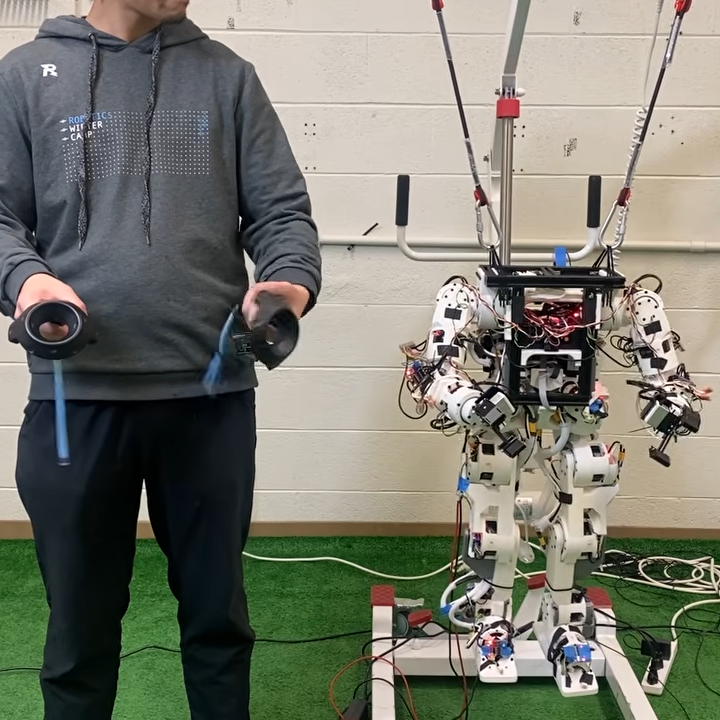
Humanoid robots, even scaled-down ones, tend to be expensive. The Berkeley Humanoid Lite offers a more accessible and economical option by centering the design around 3D printed actuators that make up the bulk of the robot’s frame.

The actuators are made by combining motors with printed cycloidal gearboxes and an embedded magnetic encoder. They’re modular, so even if one has no desire to recreate the whole robot it might be worth checking out the actuator design details to see if they might be useful in some other way.

The Berkeley Humanoid Lite isn’t a finished product so much as an open-source, easily customized reference design. The GitHub repository contains everything one might need, and you can watch some basic demonstrations, including VR-driven teleoperation, in the video embedded below.

At a total hardware cost of under $5,000 USD it’s still expensive, but much more economical than other humanoid robots, open-source or not. As mentioned, even if one doesn’t plan to build one, the modular actuator design is worth keeping in mind for other purposes.

This Library Needs to Be At Least… Three Times Bigger

28 August 2026 at 22:00

Many of us have noted a tremendous price increase in many computer components for some mysterious reason. Whatever this cause is will be debated among the various modern philosophers and Diogeneses, but regardless of cause we all still have to live in this world and make do. That turns us towards getting maximum value from the things we already have rather than trying to go out and buy more computer components right now, like [svofski] using his vast swath of existing microSD cards to build an SD card library.

The library is based around a tiny robotic arm that can physically grip the cards and move them in and out of a reader. The first iteration of the arm involved rotating the two pincers, but this turned out to be overly complicated and [svofski] eventually settled on a design resembling a rack and pinion that slides the two pincers together instead. With the gripper sorted out, it’s placed in system called T-bot arrangement, similar to coreXY kinematics, that lets it pick and place among 12 microSD card slots.

Many of the parts in this build were directly from or inspired by 3D printers, making it relatively simple with so many parts available. [svofski] didn’t build it for a specific use case, though; mostly it was constructed out of fascination for robotic tape changers which perform a similar function. But for anyone who actually needs to duplicate a large number of SD cards, or other types of removable media, this could prove to be a fairly handy robot.

3D-Printed Skin Gives Robots the Sensation of Touch

24 August 2026 at 22:00
Schematic diagram of the touch-sensitive skin. (Credit: Haofeng Chen et al., ArXiv, 2026)

Hypoesthesia, more commonly referred to as numbness, is one of the more distressing ailments that can affect us humans, primarily because it reminds us of just how much we rely on our sensation of touch in daily life. From experiencing the world around us, handling objects, noticing when you just bumped into that side table again and the comforting hug of a fellow human being, touch is perhaps the most important of our senses.

In that regard the recently published research by [Haofeng Chen] et al. on giving robots a skin that can experience touch seems rather important as it would give especially humanoid robots a more natural way to interact with their environment, using feedback from touch.

Poking the artificial skin. (Credit: Chen et al., arXiv, 2026)

One of the essential parts of biological skin is that it is teeming with sensors, at a density level that provides excellent resolution as required, down to sensing e.g. small surface imperfections with one’s finger tips. Replicating this with an artificial skin for robotics has always been a problem, due to the wiring and/or reliability nightmare this poses with typical approaches. Instead of focusing on many individual sensors, [Chen] et al. focused on effectively creating the equivalent of a resistive touch screen in skin format.

The basic principle underlying the demonstrated artificial skin is electrical impedance tomography (EIT), which uses surface electrodes to form a tomographic image based on measures electrical resistivity. Core here is the flexible TPU layer with electrodes and the conductive fabric patches attached to the top TPU cover layer. The electrodes continuously measure the resistivity, with disturbances from those patches due to touch events on the cover layer altering these values. From this EIT can be used to reconstruct the location and strength of the touch event.

The results from the created prototypes were promising, with only 16 electrodes sufficing to create a fairly accurate pressure map. Hardware-wise this makes it thus quite uncomplicated, with the characterization of the TPU porosity and such along with the EIT algorithm (provided in the paper) probably being the biggest hurdles for hobbyist recreations.

Using Acoustic Resonators as Thrusters for Small Robots

18 August 2026 at 01:00

There are quite a few rather unconventional methods of propulsion, but perhaps one of the more curious approaches involved Helmholtz resonance, as demonstrated by [Junsun Hwang] et al. with a paper inΒ Science Advances and associated summary article by EPFL’s School of Engineering.

Although probably better known from something like musical instruments, Helmholtz resonance can be used for more than creating or deadening noise. If stimulated with an external acoustic source that matches the chamber’s resonance frequency the result is a jet of air at the neck of the chamber. This acoustic actuation can thus be used for a number of applications.

In the paper a number of such applications are demonstrated, including a boat with three of these chambers for propulsion and steering, as well as a microflier (see above image) that when placed above an ultrasonic phased area will hover due to the production of this jet of air.

This microflier concept was then adapted with angled resonator chambers so that they could drive a propeller. Naturally, the produced thrust is only a fraction of a Newton so it’s essential to make these structures as light as possible, in the order of micrograms. These microfliers were created using high-resolution 3D printing, with a few iterations attempted to determine the optimal configuration.

In the case of the boat the ultrasonic transducers were directly placed on the bottom of the resonance chamber, but in the case of the microfliers the weight limitations necessitate these transducers to be external. Even if not the most practical kind of flying robot, as a demonstrator of this application of Helmholtz resonance for acoustic propulsion it’s pretty cool.

❌
❌