The SLS (Space Launch System) core stage is lifted from the transfer aisle of the Vehicle Assembly Building at NASA’s Kennedy Space Center in Florida on Thursday, Oct. 22, 2026.
NASA/Sean Cannon
The SLS (Space Launch System) core stage is lifted from the transfer aisle of the Vehicle Assembly Building at NASA’s Kennedy Space Center in Florida on Thursday, Oct. 22, 2026.
NASA/Sean Cannon
The SLS (Space Launch System) core stage is horizontal in the transfer aisle of the Vehicle Assembly Building at NASA’s Kennedy Space Center in Florida on Friday, Oct. 23, 2026.
NASA/Cory S Huston
The SLS (Space Launch System) core stage is integrated alongside the twin solid rocket booster motor segments on Sunday, Oct. 25, 2026, inside the Vehicle Assembly Building at NASA’s Kennedy Space Center in Florida completing its short stack configuration.
NASA/Sean Cannon
The SLS (Space Launch System) rocket core stage is integrated with the solid rocket boosters for Artemis III in High Bay 3 of the Vehicle Assembly Building at NASA’s Kennedy Space Center in Florida to complete its short stack configuration.
NASA/Frank Michaux
NASA’s Artemis III SLS (Space Launch System) core stage is integrated alongside the twin solid rocket boosters on Oct. 28 inside the Vehicle Assembly Building’s High Bay 3 at NASA’s Kennedy Space Center in Florida.
Technicians lifted the 212-foot rocket stage from the facility’s High Bay 2 using a one-of-a kind lifting beam designed to place the stage onto the mobile launcher. Once testing and checkouts are complete, teams will roll the core stage and booster stack out to Launch Pad 39B to conduct a tanking test where liquid hydrogen and liquid oxygen fuel will be loaded only into the core stage and launch teams will practice countdown procedures and timelines.
The Artemis III mission will launch NASA astronauts Randy Bresnik, Frank Rubio, Andre Douglas, and ESA (European Space Agency) astronaut Luca Parmitano in the Orion spacecraft on top of the SLS rocket to test rendezvous and docking capabilities between Orion and commercial spacecraft from Blue Origin and SpaceX ahead of future mission to land astronauts on the Moon.
Photo credit: NASA/Sean Cannon, Cory S Huston, and Frank Michaux
As the supercooled propellant flowed into the core stage, and NASA’s SLS (Space Launch System) rocket roared to life, Allison Mjoen and her family watched with awe and pride. Mjoen, NASA’s operations manager for the agency’s Exploration Ground Systems Program, helped shape the systems and ground operations that will one day send humans back to the Moon. Over her 20-year career at NASA’s Kennedy Space Center in Florida, she supported missions across the Space Shuttle Program, the International Space Station, and now she is applying that experience to Artemis.
April 1, 2026, was a bright, crystal-clear day along the Florida Space Coast. The sunlight seemed to sharpen every color along the horizon. As Mjoen and her children counted down and the crowd’s voices rose around them, the rumble of the SLS rocket intensified beneath their feet. For her children, it was the chance to see what their mom had helped make possible. For Mjoen, it was a moment she would never forget.
That moment also offered a pause for reflection on the work that led her there. As the spacecraft offline operations manager, Mjoen coordinates the work that happens long before launch day. By supporting the ground systems’ senior vehicle operations manager, Matt Czech, she develops integration plans and oversees ground operations for Artemis vehicle processing, focusing on booster and Orion spacecraft operations.
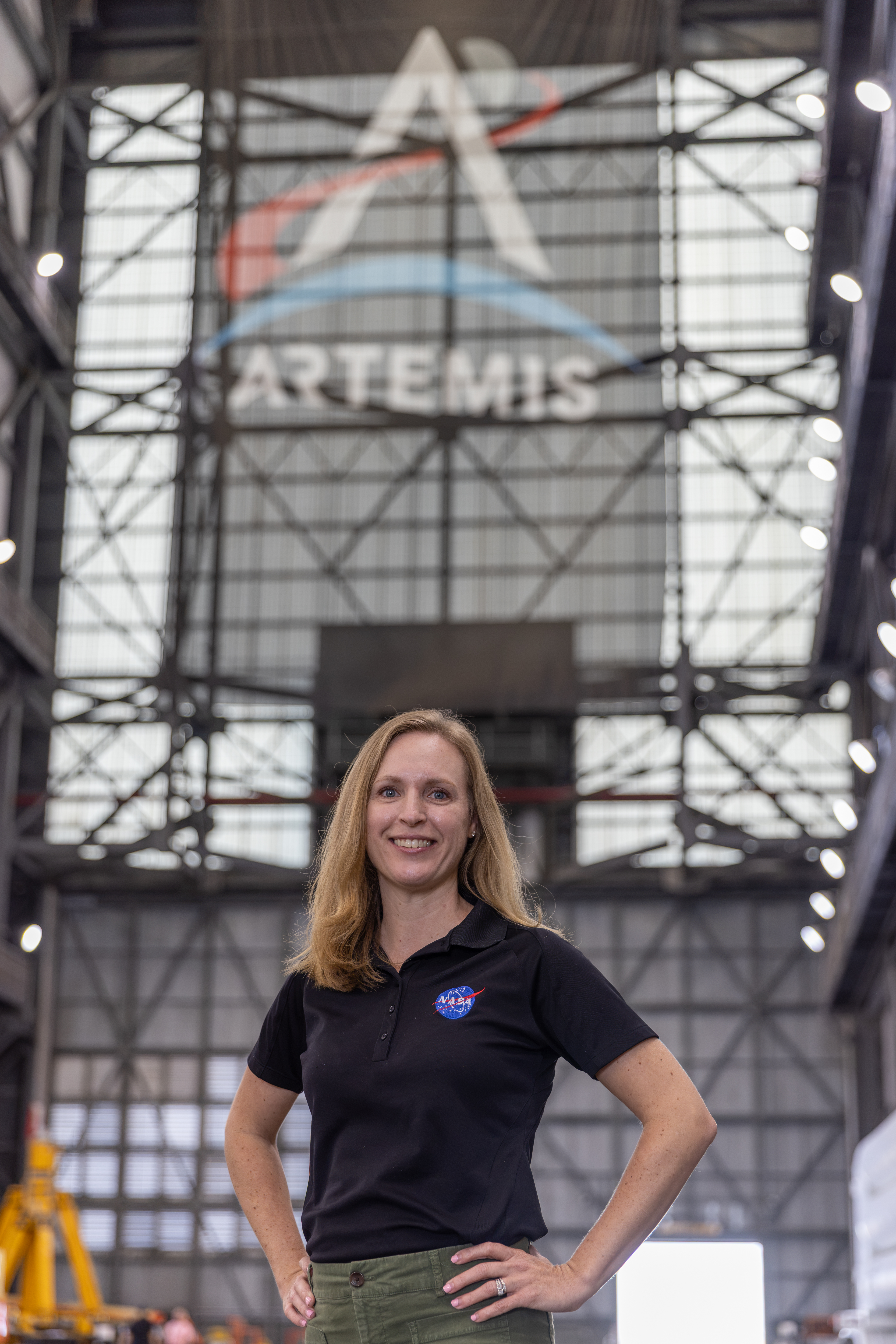
Allison Mjoen, NASA’s operations manager for the agency’s Exploration Ground Systems Program, helped shape the systems and ground operations that will one day send humans back to the Moon.
NASA/Amber Jean Notvest
Mjoen began her career as a flight crew systems engineer with United Space Alliance supporting the Space Shuttle Program. Her team handled mission-specific cabin configurations, including the food, spacesuits, cargo, and payloads astronauts needed aboard the shuttle.
After the Space Shuttle Program retired, she supported the International Space Station Program as a payload integration engineer. In this role, she connected experiment investigators with the organizations developing their hardware. She later worked in the Project Office on the Test and Operations Support Contract before joining NASA’s Operations Project Engineering Office, where she served as the Spacecraft Payloads Integration and Evolution Element lead for Artemis I.
“Early on, I thought every decision had to be perfect, but everything is an opportunity to learn, especially the tasks that seem unrelated at the time. It’s about staying curious, working hard, building relationships, and trusting that each step is preparing you for the next one.
Allison Mjoen
Operations Manager, NASA's Exploration Ground Systems
That preparation took on new meaning when she first supported integrated firing room operations as a certified operations project engineer during Artemis I. Earning the certification was a milestone. Applying it during real time operations brought a new level of responsibility.
“Every decision and communication directly supported the integrated team’s ability to execute safely and properly implement the test procedure,” said Mjoen.
Working at the integration console underscored the importance of preparation, collaboration and trust — lessons she carries into her work coordinating across teams today.
“I get to collaborate everyday with incredibly talented and dedicated people who are all working toward the same goal. It’s especially rewarding to know that our collective efforts directly contribute to the success of the mission.”
Allison Mjoen
Operations Manager, NASA's Exploration Ground Systems
For Mjoen, the shared experience is part of what makes Artemis so important. As the Artemis program continues, she looks forward to another moment families will be able to share as astronauts return to the lunar surface.
“That single moment captured the imagination of people around the world and showed what is possible when we come together for a bold goal,” she said of the first Apollo Moon landing. “Artemis is creating that kind of moment for a whole new generation, and this time to stay.”

 Login