❌

Normal view

There are new articles available, click to refresh the page.
Yesterday β€” 28 October 2026Main stream

SLAM Navigation For an Arduino Powered Car

28 October 2026 at 04:00

There are plenty of β€œrobot” projects out there that are really just a small remote control platform of some sort. We often like to think of robots of having some sort of autonomy though. [Luca Fagioli] demonstrates a great example of this with his explorer robot that uses Simultaneous Localization and Mapping (SLAM) to navigate its environment.

The robot is a built on a small plastic chassis, with one gear motor per drive wheel. Running the show is an Arduino Uno R4 Wi-Fi, paired with the Sensor Shield 5.0 and an L298N motor driver board. There’s also an HC-SR04 ultrasonic sensor module onboard, mounted atop an SG-90 servo motor so it can be panned around. The ultrasonic sensor determines the range between the robot and surrounding walls, and a map is constructed at the same time as the robot is localizing itself within it. There are also infrared sensors on the bottom of the robot for detecting tape marks on the floor for checkpointing purposes.

Often, SLAM mapping is done with advanced laser rangefinders or time of flight sensors, but there are many ways to go about it as this project demonstrates. We’ve even seen it done in a distributed manner with coordinated drones combining their efforts. Overall, it’s a highly useful technique for robot navigation and wayfinding.
Before yesterdayMain stream

Birduino Plays Bird Calls on Demand with NFC-enabled Cards

20 October 2026 at 01:00

All [Hannah Robertson]’s Birduino needs is for one to tap an NFC-enabled card to the reader, and the device plays one of the vocalizations associated with the bird shown on the card. It ties together a few different components into a whole, and acts as a good reference design for similar work. There are a few time-saving construction tips worth keeping in mind, too.

The major components are an Arduino Nano, an RC522 RFID reader, and an MP3 player module. Using hardware modules and breakout boards means simpler wiring and being able to take advantage of existing libraries and sample code. There are also a few other things in this build that avoid re-inventing the wheel.

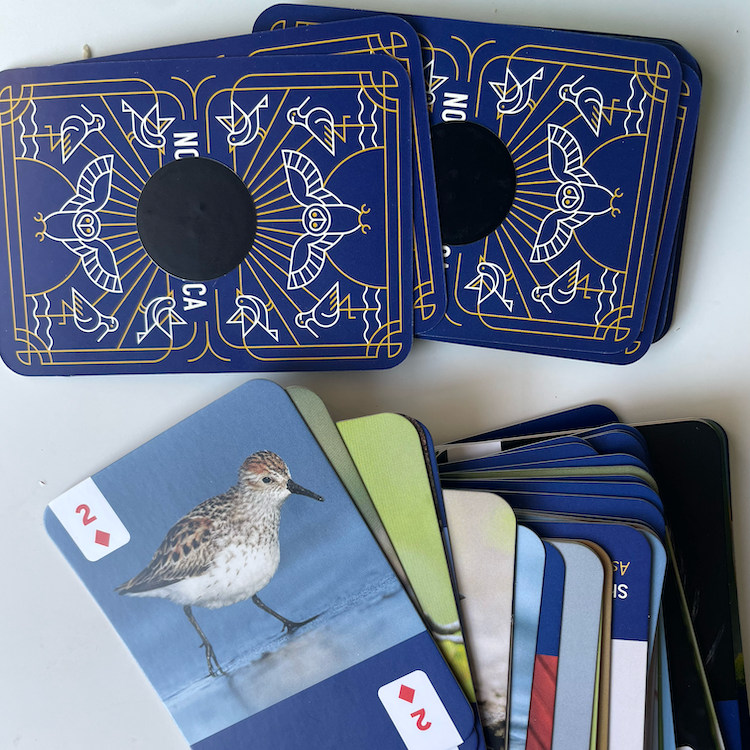
A deck of bird cards plus a roll of NFC stickers equals a ready-to-scan assortment without having to design it oneself.

Rather than design, print, and cut a set of bird cards, [Hannah] found a set of bird-themed playing cards with a different North American bird on each. The back of each card gets an NFC sticker off a big roll purchased online. The result? A set of NFC-enabled bird cards with a minimum of work and fuss. The RC522 RFID reader doesn’t fully support NFC, but it works well enough to read the ID off the stickers.

When the user touches a card to the reader, the device plays one of the vocalizations from a collection of sounds for each bird. Creating the manifests and linking each card’s ID to them was a lot of manual work, but the result is great. The sound themselves come from the Cornell Guide to Bird Sounds of the United States and Canada, a $20 USD curated compilation of vocalizations from a staggering 908 bird species of North America. In a way, the biggest bottleneck is the card deck itself. At 52 cards plus two Jokers, it contains only a small subset of the total birds in the Cornell collection.

The enclosure is laser-cut clear acrylic, and here [Hannah] offers some time- and money-saving advice for anyone looking to glue acrylic to acrylic in a way that doesn’t frost or cloud the clear acrylic: Clear Gorilla Glue Gel. There are of course other glues made for this purpose, but Clear Gorilla Glue Gel (the one in a squeeze tube) is something one should be able to find in just about any hardware store. Another tip: double-check before buying, because many Gorilla Glue products are very similarly named despite being significantly different products.

Watch (and listen to) the video embedded below. If birds and their vocalizations are something that intrigues and inspires you, Cornell also has a resource for identifying birds by sound alone β€” we’ve seen it implemented with a Raspberry Pi and USB microphone.

❌
❌