
❌

Normal view

There are new articles available, click to refresh the page.
Before yesterdayHackaday

Hand-Coded ASM Powers Homebrew SNES Game

11 September 2026 at 14:30

Nintendo has made many game consoles in its long history β€” one that famously overlaps that of the Ottoman Empire β€” but only one of them was ever Super. It’s that console, the Super Nintendo Entertainment System, that [Inkbox] has decided to delve deeply into as he crafts a game in assembly using all the hardware tricks he can.

Hardware tricks he’ll need, given he’s limited to the two 64 kB RAM banks and 3.58 MHz Ricoh 6502-based CPU. Even the 4 MB limit he sets for a historically-accurate homemade cartridge seems positively claustrophobic by modern standards. The game he’s after making is a top-down adventure game a la Zelda, and [Inkbox] gets right into the weeds explaining how the SNES works as he shows his work in this nearly hour long video. If you’re looking for a deep dive into the architecture, along with how it is meant to be used, you could certainly find worse sources. Everything from the different graphics modes to what registers handle sound are covered in this and the previous video in the series.

We can’t help but call out his dedication to open source β€” the SNES Sound Engine he has put up on GitHub looks like it could be a real asset to anyone else doing this kind of homebrew. The game itself is on itch.io and is pay-what-you-want.

[Inkbox] doesn’t just limit himself to the SNES’s 6502-esqe assembly β€” he’s done impressive work in x86 ASM, too.
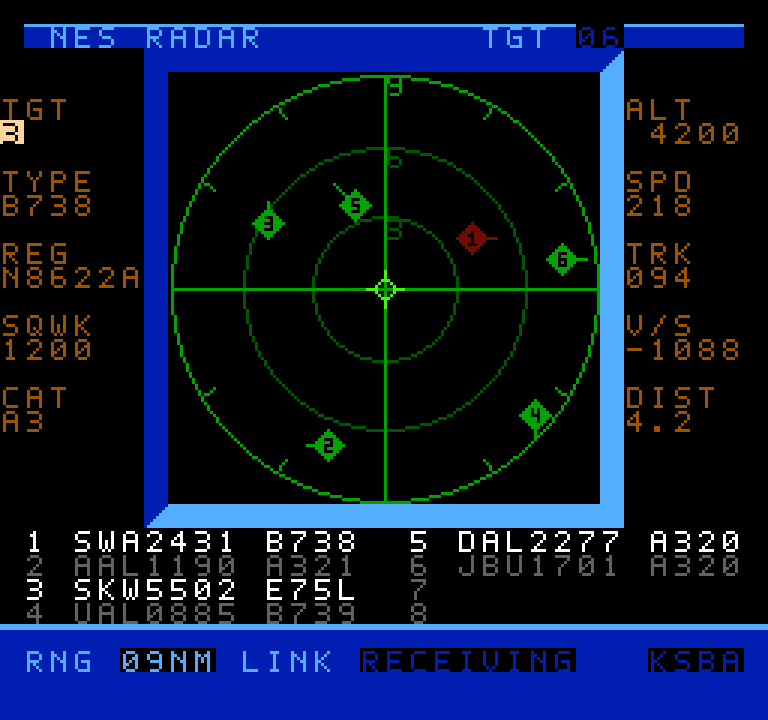
NES Radar Tracks Flights at 9600 Baud

7 September 2026 at 01:00

Air traffic visualizers seem to be having a bit of a moment right now, and now that moment has come to the venerable NES thanks to [k6lcm]’s NES Radar project, which is open-source under the GPL on GitHub. In spite of the name, there’s no Radio Direction or Range-Finding involved in this project– no radio at all, in fact, which makes this a bit interesting. It’s just an NES cartridge and a carefully constructed cable.

A screenshot of the NES radar scope
It looks like a period game, but it’s current-day air traffic.

The cartridge is a standard ROM cart that holds the software β€” no hidden ESP32 or PicoW here, which is what we initially suspected the project would be. So how is it that when you start up the NES with the cartridge inside, you can input an International Civil Aviation Organization (ICAO) code, like, say, KATL, and get a visualization of the traffic? Well, okay, if you put in KATL, you won’t get all the traffic, since the software is limited to 8 sprites, and that’s the world’s busiest airport. Still, how does it know where those airplanes are?

The secret is in the carefully constructed cable mentioned above: this project is using the second controller port on the NES as a serial port, and getting the data that way. A handy Python script on a nearby computer is what actually fetches aircraft positions. It’s based on c64u-radar, also by [k6lcm], which does the same Python server trick but relies on the Commodore 64 Ultimate’s LAN port to get data rather than using serial. The NES has no such ports available, though, so the controller port it was. We saw a similar trick used for satellite tracking on the NES some years ago.

If you like the idea of tracking flights, perhaps you’d like to see it done on a real radar CRT, or projected directly onto the ceiling. Thanks to ADS-B and free APIs, it seems airplane trackers are everywhere; if an interesting one has come onto your radar, please send us a tip.

Speaking of tips, thanks to [Levi] for putting this one on our scopes!

Using the Basic SNES Hardware to Play Minecraft

23 August 2026 at 16:00

After previously putting a very basic version of Minecraft on the Game Boy Color, [Tobi] decided to have some fun and port that version also to the Super Nintendo (SNES), just to see what would happen with its more powerful hardware. Even without using an add-on chip like the Super FX 3D chip that made games like Star Fox and Doom possible with its 3D-rendered geometry, the basic SNES hardware can already provide a serviceable Minecraft experience.

You can download the SFC file here, featuring a starting world in which you can do all the usual Minecraft-ing shenanigans, like world destruction and construction. Unsurprisingly the game’s resolution is much higher than on the GBC, though the brief glimpse [Tobi] shows of Minecraft on the Game Boy Advance (GBA) with its proper 3D-rendering hardware are leaps ahead of what the basic SNES can do.

This of course raises the question of what Minecraft on the SNES could look like once you add the Super FX or similar 3D accelerator chips for the SNES into the mix. Rather than just being limited to sprite-based graphics and transformations, suddenly you can use real polygons.

❌
❌