
❌

Normal view

There are new articles available, click to refresh the page.
Yesterday β€” 27 July 2026Hackaday

Regain Some Trust in Unknown USB Drives

27 July 2026 at 14:30

For how useful USB thumb drives are for quickly toting around and copying files from one computer to another, they can be a bit of a security headache. Programs can be loaded on them with all kinds of malware; they can be obscured in some ways that are difficult to detect, and they can be set up to execute certain programs when they’re plugged in. The general wisdom is to simply avoid untrusted USB devices completely, but that sort of abstinence-only policy rarely works in the real world. If, for some reason, an untrusted USB device absolutely needs to be used, many of these security issues can be mitigated with this tool.

Built by [Novamostra], the device is simple on the surface: it’s a Raspberry Pi Pico mated to a 2-in-1 USB splitter cable. But with the USB Neutralizer software they have written loaded onto the Pico, it automatically destroys the ability of any connected USB thumb drive to load files. The program works by deleting the first and last 34 Logical Block Addressing (LBA) sectors on the drive immediately when it’s plugged in, without doing anything else. This effectively corrupts the drive bad enough to prevent malicious software in the partitions from doing anything, allowing the user to (relatively) safely put the USB drive into their computer and format it for re-use. The code for this tool is also open-source and reviewable on the project’s GitHub page.

Of course, this isn’t a perfect security solution for all USB attacks. It doesn’t erase or replace the firmware on the drive itself, and although firmware-level attacks are rare they’re not out of the question for all users, all the time. It also won’t prevent a malicious physical attack like this high-voltage one, and it may also not stop hidden or obscured partitions or devices programmed for storage and some other nefarious purpose simultaneously, like a USB HID. But still, this solves a great many of the problems associated with getting new drives from semi-untrustworthy sources, like retailers or friends whose computer skills we don’t fully trust.
Before yesterdayHackaday

Open-Source Mid-Drive e-Bike Motor Has Lots of Promise, and Hyphens

19 July 2026 at 01:00

[Pedro Neves] has a mid-drive e-bike, but he doesn’t own it β€” not truly, since he can’t repair the motor unit. For a hacker to be in that position, there are only two options: crack the old one and make it your own, or build your own from scratch. [Pedro] built his own and is open-sourcing it on his website for everyone to play with. Right now, that’s .step files and a BOM, so you’ll need to watch the design/build video on YouTube below to get the full picture.

His choice of a motor from an old battery-powered angle grinder is both thrifty and environmentally friendly, so we approve. His goal of 25 km/h seems like a reasonable speed limit, but may still be too fast for some countries’ regulationsβ€” so do check the local rules if you’re going to build this. Making the most of 3D-printed components is also a choice that makes the project more accessible, but don’t worry β€” the bearing surfaces are all metal. That includes the clutch bearing that will let you pedal home if the battery dies or the motor craps out. Well, unless the printed plastic axle gives up the ghost, but that got replaced with a CNC version, so it’s all good. Unless you’ve got legs like Hercules, it ought to hold.

If that’s not DIY enough, you could always build the motor yourself. This mid-drive is also part of a larger project [Pedro] is working on for a whole cargo bike, as he details in his video, which is a worthy project we’ve seen other examples of before.

It’s Now Imperative That You Copy That Floppy

By: Tom Nardi
7 July 2026 at 22:00

In the early 1990s, Don’t Copy That Floppy was an anti-piracy campaign that attempted to connect with computer-savvy youth through the power of hip-hop. While somewhat difficult to imagine given our current draconian Digital Rights Management (DRM) hellscape, warning kids about the potential legal ramifications of duplicating floppy disks containing copyrighted software was seen as necessary since at the time there was usually nothing preventing users from simply copying the contents of one disk to another.

Unfortunately 30+ years down the road, we’re now finding that somebody really should have been backing up some of those disks. Which is why the University of Cambridge of launched the Future Nostalgia project and produced Copy That Floppy! β€” a phenomenal guide on preserving the contents of floppy disks while we still can.

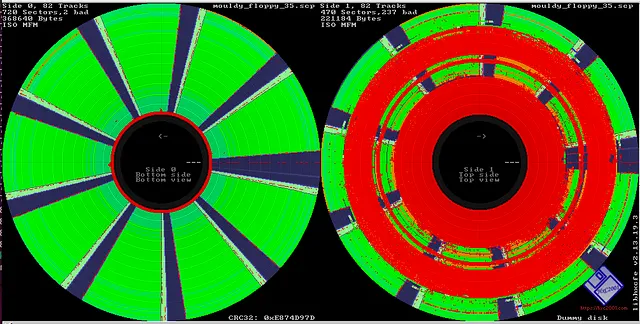
Visualizing a disk’s flux stream can identify debris and damage.

There’s no telling how much data could potentially be lost to time because its stuck on such an antiquated and fragile storage media, and the situation only gets worse with the passage of time. The problem isn’t just that modern computers don’t have floppy drives. The disks themselves degrade with age, a process which is accelerated if they aren’t stored properly.

As such, Copy That Floppy! only briefly touches on the most ideal situation β€” that is, buying a USB floppy drive and making copies of the bog standard 3.5 inch disks you might come across. It then moves right on into more advanced topics, such as interfacing with less common drive types, how to safely clean floppies, and the use of advanced tools such as Greaseweazle to analyze captured disk images.

We’ve seen demonstrations of some of these techniques before, and a few years back Adafruit got interested in floppy preservation with modern hardware. But in-depth guides like these that pull all that information together into one place are valuable resources.

❌
❌