Call it by any name it has a lot of nutritional value and is a powerhouse of nutrients. Snake gourd belongs to the summer squash family, mostly a summer produce ,it is available all round the year in India.
Rich in dietary fiber , vitamins A and C ,snake gourds help in digestion ,prevent bloating and constipation . Helps in detoxification of the body because of its diuretic properties. Due to water content present in the snake gourd it helps maintain body's hydration.
Podalangai Thayir pachadi is a new addition to my kitchen and hence it is making it to the blog .
Amma would make it frequently during summer, but over the years I had totally forgotten about this recipe . As a flash,this recipe occurred to me this morning when I was contemplating what to make with fresh and tender snake gourd that I had just bought. The snake gourds have to be tender. Overly ripe ones taste bitter and become hard and chewy . So while buying, make sure the snake gourd vine is easy to twist and tender to feel. If you find it hard or it easily cracks ,then don't buy that .
Podalangai thayir pachadi is very easy to make and gets done in no time . A tasty paste is made using fresh coconut, ginger,green chillies and curry leaves which is added to thick whipped yogurt and boiled snake gourd is mixed along with this followed by a tempering of mustard, dry red chillies and asafoetida.
Podalangai thayir pachadi is also made during Amavasya, pithrupaksha and Shraadh cooking in a typical Tamil Brahmin household . Vishu and Onam Sadhyas also feature padavalanga kichadi as one of the Sadhya menu items.
Officially, though it is still winter/spring in India , we are already feeling the warmth in my part of the city. There is hardly any chillness felt and the afternoon sun is at its peak .
As always, with summer setting in; buttermilk,lassi,raita and yogurt based curries make a lot of appearance in my kitchen . Yogurt based curries are light on stomach and easy to digest as well .Most importantly it keeps the body cool during harsh summer and it maintains hydration.
Avarakkai kootu is a popular side dish from the Tambrahm cuisine made from just moong dhall (yellow split gram) , fresh coconut paste and a Sizzling tempering of mustard seeds ,curry leaves in coconut oil.
Avarakkai(tamil),Avrekkai(Kannada), chikkidkaay (Telugu) is a native Indian vegetable and used extensively across cuisines in India . In the Maharashtra and Gujarat it is called as Vaal papdi or papdi and Sem in Hindi .
Avrakkai is a diabetic friendly vegetable and also rich in protein, dietary fibre,vitamin A ,potassium and folates. Consuming avarekkai is a good source of plant protein and apt for vegetarians to meet their dietary requirements of protein intake. The fibre present in the Indian flat broad beans helps to manage cholesterol in the body.
Since, Avarekkai is a native vegetable, it is used during the Mahalaya Paksha , Amavasya cooking and also for cooking during Shraadh or Devasam. During Shraadh , Amavasai or Mahalaya paksha avrekkai is mostly used in the form of kootu but some families also make a simple stir fry known as Thenga pota curry .
I shall share the recipe of the simple yet flavorful curry very soon. You may refer to Mildly Indian Seema's Kothavarangai Poriyal and in the same way you can make avarekkai poriyal .
Avrekkai kootu can be mixed with rice or can also be served as an accompaniment to sambar ,vethakuzhambu, milagu kuzhambu along with some toasted papads and a simple paruppu Thogayal or pudina Thogayal.
If making kootu to mix with rice, make it a little runny else we can have a thicker consistency.
Avrakkai kootu is purely Saatvik and Vegan making it No Onion No garlic and Jain friendly .
You may also want to try some lip smacking healthy and delicious kootu recipes from my blog
Preparation Time - 10 mins Cooking Time - 25mins Complexity - Simple Serves - 2 to 3
Ingredients
150 gms Indian broad beans /avarekkai 1 cup moong dhall 1/2 cup fresh grated coconut 1 tsp jeera/cumin 8 to 10 pepper corns 2 dried red chillies Few curry leaves Pinch of turmeric Salt as needed 1 tsp coconut oil 1/2 tsp mustard seeds Pinch of asafoetida
Method
Wash the broad beans and trim the head and tail. Bundle them up and chop into medium cuts.
Wash the moong dhall under running water 3 to 4 times.
Add the washed moong dhall,chopped avrakkai ,turmeric , 2 cups water and pressure cook for 3 whistles. Let the pressure release naturally.
Grind the coconut, cumin,red chillies ,pepper with water to a fine paste .
Once ,the pressure cools down,lightly mash and mix the lentil and add the ground coconut paste to this along with required amount of salt.
If too thick,add 1/4 cup water and bring it to a quick boil with occasional stirring. Coconut paste has a tendency to stick to the bottom and the kootu will get burnt.
Turn off the stove when the kootu thickens and the raw flavor from the coconut paste is gone.
Prepare a tempering of mustard seeds,fresh curry leaves,asafoetida in hot coconut oil and pour it over the delicious kootu.
Thai Amavasai , Aadi Amavasai and Mahalaya Amavasai are very significant for Tamil people . The ancestors ,our pithrus are worshipped on Amavasai and the family seeks the blessings of our forefathers for the family's wellbeing.
Aadi Amavasai is observed in the Tamil month of Aadi / Aashada / Karka (cancer) between July 15th and August 17th.
Aadi Amavasai is the first amavasai that falls after the start of Dakshinayanam . Dakshinayanam is when the sun moves to the south of Equator . In western India, it is known as Ghatari Amavasya .
Like every other Amavasai, the pithrus are worshipped and the whole family seeks their blessing . It is believed that those who observe Aadi Amavasai their families are blessed with good luck,peace and prosperity by their ancestors. Tamil Brahmins offer tharpanam around mid morning and offer Dakshina to the Vadhyar / priest . Tharpanam is offered only by the sons who have no father .
According to Garuda Puranam, offering black til (sesame seeds) and water to forefathers on this day will please them and they shall bless you with longevity, success, progeny and relief from debts.
My prasadam platter above was prepared for last year's (2023) Aadi Amavasai .In 2024 ,Aadi Amavsai is on Aug 4th 2024 .
As like every other special occasion, even Aadi Amavasai is celebrated with an elaborate meal spread offered to our pithrus . Each family has their own tradition of preparing the food . In a typical Tamil brahmin home ,we make Vadai and Payasam along with Raw Banana (vazhakkai) curry , pepper based kuzhambu , jeera pepper rasam ,cucumber pachadi ,boiled moong dhall .
In Maharashtra and Gujarat ,people feast and rejoice on Ghatari amavasya as Shravan Mahina commences on the day after Amavasya and people observe Vrat/fasting and refrain from eating non veg during Chatur Maas .
This year in 2024 it is celebration galore continously .
Incase you don't have time to prepare such an elaborate menu for Amavasai, you can look up my post on Basic Amavasai Thaligai and cook up and simple, yet authentic offering for Amavasai.
Raw mangoes mark the beginning of summer and the pickling season. Apart from making pickles ,raw mangoes can be used in a variety of recipes in our day to day cooking.
The sourness, tartness and a mild hint of sweetness adds up a lot of flavor profile to the recipe. Earlier we had to wait for summer to get good Raw mangoes, but now with so much improvement in cold storage facilities, we do get good Raw mangoes all through the year .
The current situation in Indian markets,is the cost of tomatoes which are sky high and we have to use them sparingly . In these times,Raw mango sambar has come to my rescue. Raw mangoes are a perfect work around for tomatoes.
Depending on the tartness/sourness in the raw mango we can adjust the usage of tamarind pulp. Most of the times we don't need to use tamarind as the sourness from the mango balances the flavors well .
I use some vegetables like pumpkin and capsicums in my sambar recipe because we like to have lots of veggies in the sambar . You can also use carrots ,drumsticks ,Brinjals as well in this same recipe.
Piping hot sambar mixed in rice with a dollop of ghee is just out of the world . Pair this sambar with a coconut based vegetable stir fry and serve along with some papads to enjoy a wonderful lunch experience.
In our Facebook gourmet food group Shh Cooking Secretly!!! , we are sharing Mango based recipes for the month of June .
Anu Kollon who hosted the theme, suggested we use mango in any form, either raw or ripe in our recipe. I have used raw mango as the star ingredient while my partner Narmadha has made Mango Popsicles using ripe mango .
If you are looking to exploring some lipsmacking recipes using raw mango ,you must definitely check out my list below .
Preparation Time - 15 mins Cooking Time - 20 to 25 mins Complexity - Simple Serves - 3 to 4
Ingredients
100 gms pumpkin
1 medium sized capsicum/green bell pepper
1 medium sized raw mango
3 tbsp sambar powder
3/4 cup thoor dall /pigeon peas
Pinch of turmeric
Salt as needed
2 tsp oil
1/2 tsp mustard seeds
Fresh curry leaves
1/2 tsp jaggery powder
Fresh corriander chopped
Pinch of asafoetida
Method
Chop the capsicum,pumpkin and mango into medium sized cubes .
Add 3/4 cup water ,Pinch of salt and cook the vegetables until they are well cooked. The vegetables must be firm ,yet well cooked . Donot keep stirring with the ladle,they will become mushy.
Meanwhile ,wash the thoor dhall well and pressure cook it with turmeric for 4 to 5 whistles with sufficient water. Release the pressure naturally and mash it well using a whisk or hand blender . The dhall must be soft and mushy.
Once the vegetables are well cooked, add the sambar powder ,jaggery ,some more salt and bring it to a rolling boil.
Slowly add in the cooked thoor dhall, adjust the consistency of sambar by adding some water if needed and let it come to a boil . You can add some sambar powder if you feel the spice is less.
Prepare a tempering of mustard seeds,asafoetida and curry leaves in hot oil and pour it over the sambar .
Garnish with fresh corriander and turn off the stove.
Pumpkin is a versatile vegetable and is widely used in the Indian cuisine .Various names of pumpkin in different languages, Parangikkai /Thadiyangai (Tamil) , Mathan (Malayalam) , Kaddhu (Hindi) , Laal Bhopla (Marathi) , Sihi Kumbalkkai (kannada) ,Kumdo /Kumro (Bengali) and so on.
In India, pumpkins are available through the year unlike the western world wherein it is a Fall produce and available only during Autumn .
Having said that, in India we use pumpkin a lot across the length and breadth of various cuisines from Kashmir to Kanyakumari and Gujarat to Assam .
Parangikkai Vethakuzhambu is a classic recipe from Tambrahm kitchen and makes for a yummy main course . Vathakuzhambu is a tamarind based gravy without the lentils and is paired with rice and a simple vegetable stir fry or keerai masiyal.
"Vathakuzhambum Sutta appalam um" is an eternal favorite combination in most households and our home is not an exception either .Certain terminologies lose the charm when translated, but for the ease of my readers let me translate it .. the term means Vathakuzhambu and roasted papad is the best combination when served hot .
Vethakuzhambu has a good shelf life and can stay well upto 4 or 5 days when refrigerated provided your family doesn't polish off this yumm gravy. Vathakuzhambu certainly tickles and rejuvenates our taste buds and appetite especially after heavy festive indulgence or even post traveling.
I have quite a few variants of Vethakuzhambu and tamarind based gravy which I am linking below for your easy reference
Preparation Time 10 mins Cooking Time - 30 mins Complexity- simple Serves - 2 to 3
Ingredients
1.5 cups chopped pumpkin Small lemon sized tamarind soaked in hot water 1.5 tbsp sambar powder 1tsp thoor dhall 1/2 tsp mustard 1 tbsp oil 1 tsp sesame oil /til oil Salt as needed Few curry leaves Chopped corriander Pinch of asafoetida
Method
Extract the puree from the soaked tamarind, strain it.Add 1 cup water to it and set aside.
Heat oil in a thick bottomed kadai and splutter the mustard seeds followed by curry leaves, corriander, thoor dhall and asafoetida.
Saute the chopped pumpkin cubes with sambar powder and add 1/2 cup water .let the pumpkin cook well .It should be well cooked, but firm at the same time
Add the tamarind extract, required salt and let it boil well and the raw flavor of tamarind is lost .Continue to simmer the vathakuzhambu until it reduces and becomes slightly thick in consistency like tomato puree. The kuzhambu shouldn't be very runny.
Turn off the stove and drizzle the sesame oil all over and a delicious Vethakuzhambu is ready to be enjoyed .
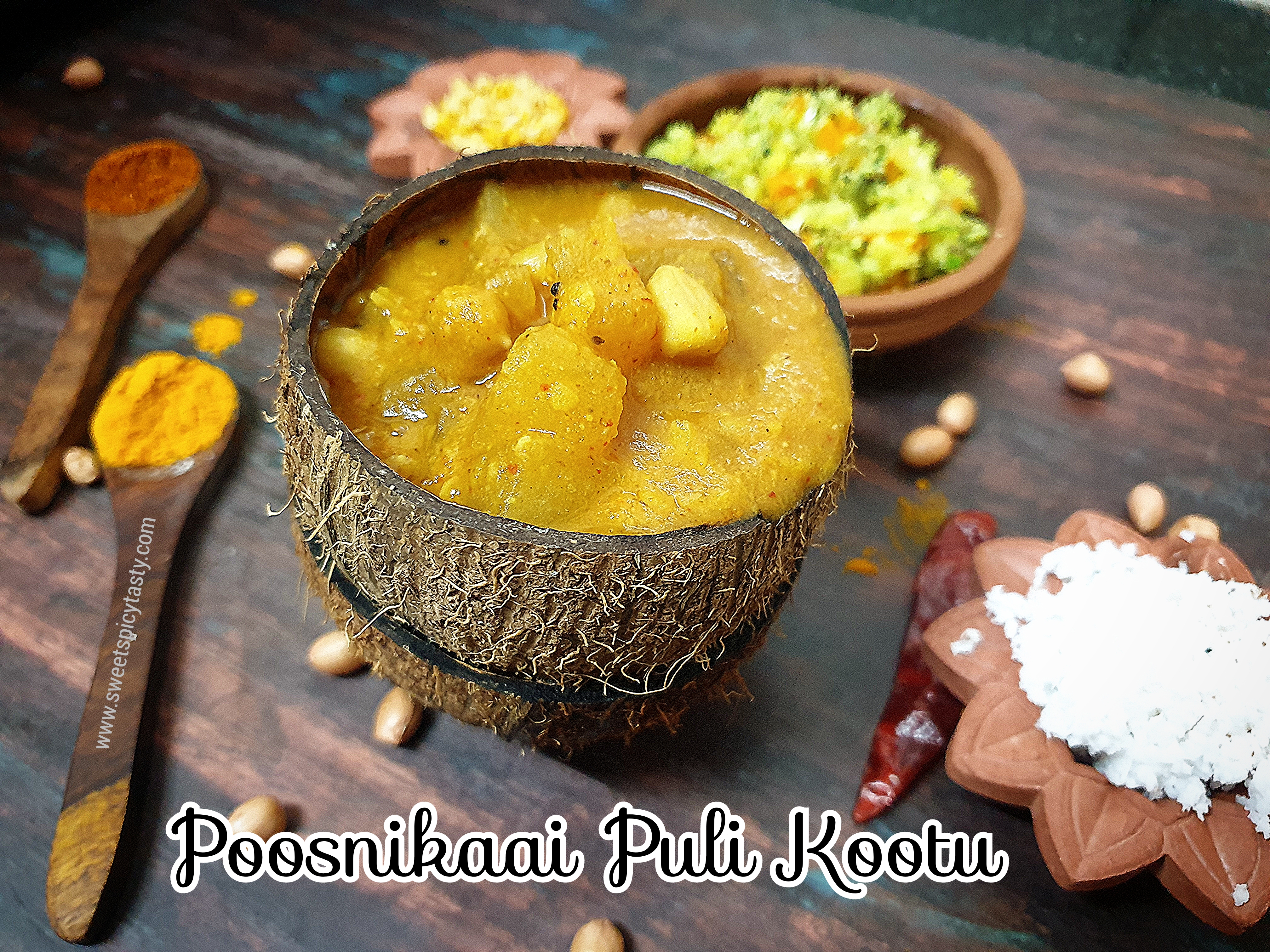
Puli Kootu or Pulippu Kootu is an authentic Tamil brahmin recipe and is made quite frequently in most homes .It is a must have on the wedding feast menu and hence also known as Kalyana Kootu .
Puli kootu is very tasty as it has a balance of all flavors and the tanginess from the tamarind extract gives it an altogether different flavor profile.
Pulippu kootu fits perfectly for those following a Vegan Diet and also being a No onion No garlic recipe it is Saatvik and Jain Friendly as well.
Pulippu kootu can be made with brinjals, ash gourd /white pumpkin or chayote/chou chou . In traditional tambrahm weddings puli kootu is made from ash gourd/poosanikaai and has either boiled chick peas or groundnuts added to the kootu .
In my recipe today ,I am going to use boiled peanuts but I also make it using boiled chickpeas many a times and both of them taste really delicious.
Puli kootu with hot rice and some coconut based vegetable stir fry is an amazing combination for lunch. In my home most often the left over puli kootu is paired with chapati for night and it pairs well .
Preparation Time - 15 mins Cooking Time - 30 mins Complexity- simple Serves - 2 to 3
Ingredients
2 cups chopped ash gourd /poosanikaai 1/4 cup thoor dal /pigeon peas/thuvaram paruppu 1/4 cup peanuts Small lemon sized tamarind ball Few curry leaves Pinch of turmeric Salt as needed 2 tsp oil 1/2 tsp mustard seeds Pinch of asafoetida
To roast and grind 1 tbsp channa dal 1 tbsp dhaniya/corriander seeds 2 tbsp coconut grated 3 to 4 dry red chillies
Method
In a pan heat 1/4 tsp oil and roast the channa dhall until crisp and golden brown followed by the dhaniya and red chillies.Allow it to cool and the grind into a fine paste with coconut and set aside.
Soak the tamarind in hot water for 10 mins and then extract the pulp . Strain the impurities and keep ready .
Boil the chopped ash gourd in sufficient water until it is cooked well..it has to be firm but well cooked .
Pressure cook the thoor dhall and peanuts in 2 separate containers in the same cooker .Mash the thoor dhall well and set aside. This saves a lot of time and effort as well.
In a thick bottomed vessel,add the boiled ashgoured ,peanuts and the tamarind extract with 1/4 cup water and boil it until the raw smell of the tamarind is lost.
Next add the coconut paste , cooked thoor dhall and another 1/2 cup water and bring to a rolling boil.Adjust salt at this stage . Donot boil too much as the dhall will begin to start sticking to the bottom of the pan and it may get burnt..we don't want a burnt kootu .
Prepare a tempering of mustard seeds, curry leaves and asafoetida and pour it on the pulippu kootu.
Millets are a very good alternative to rice due to their low glycemic index (GI) value which helps in control of insulin and absorption of carbohydrates into the blood stream making it ideal for people with Diabetes.
Millets also help in weight loss as they are rich in proteins and fibre.
There are lot of millets available like Jowar, Bajra, Ragi ,Little millet, Kodo millet , Barnyard Millet etc . You can very conveniently replace the usage of rice with millet and work towards a healthy lifestyle.
I am slowly trying to transition into using millets in my daily diet and I am certainly seeing a lot of difference. Sudden hunger pangs, mid morning cravings have reduced a lot and millets keep me full for a long time.
Little Millet is known as Samo Chawal/Kutki (Hindi), Samai Arisi (Tamil), Saame (Kannada) , Samaalu (Telugu) .
Little millet is very rich in Magnesium, Vit B components and also in phosphorous and zinc which help in building energy in the body.
Making little millet poha is very easy, almost same as making the Poha using Flattened rice. You can flavor and season it with the spices of your choice.
Little millet flakes are available in most leading super markets and shops .Also there are many exclusive outlets selling millet based products from where we can procure them easily .
Preparation Time - 10 mins Cooking Time - 10 mins Complexity - easy Serves - 2 to 3
Ingredients
1.5 cups little millet poha /flakes 2 tbsp oil Handful of peanuts Handful of frozen peas (thawed ) 1tsp cumin /jeera 2 green chillies chopped Few curry leaves Salt as needed 2 tsp lemon juice Pinch of turmeric
Method
Wash the little millet flakes under running water and let it rest in a colander for 10 15 mins . The millet flakes absorb the water and turn soft.
Heat the oil in a kadai, fry the peanuts followed by cumin ,green chillies, curry leaves.
Throw in some salt and turmeric followed by the soaked little millet flakes and also the green peas .
Toss it well ,cover and cook for 3 to 4 mins . Lastly mix the lemon juice and garnish with fresh corriander and serve hot.