Normal view

There are new articles available, click to refresh the page.
Before yesterdayTech

Microsoft comms chief Frank Shaw to exit after nearly three decades shaping the company’s message

11 September 2026 at 12:00
Frank X. Shaw addresses the media at Microsoft on May 18, 2025, in advance of the Build conference. (GeekWire Photo / Todd Bishop)

It’s the end of an era at Microsoft: Frank X. Shaw, the executive who oversaw the tech giant’s communications for nearly three decades, first at an external agency and for the last 17 years as one of its senior leaders, is leaving at the end of the year.

Shaw, 64, said he’s not retiring, although he doesn’t have another job lined up. He plans to stop working for a while, do some of the things he hasn’t had time for, and then decide what’s next.

“I have had a ringside seat at some of the biggest leadership, technology, and business transformations that have ever taken place,” Shaw said, sharing the news of his departure (under embargo) in a phone call Thursday afternoon. “I just feel incredibly fortunate.”

He said he had been discussing his potential departure for some time with Takeshi Numoto, Microsoft’s chief marketing officer, looking for the right moment.

Microsoft has not announced a successor for his role as chief communications officer. In a LinkedIn post, Shaw said the company will consider internal and external candidates.

A statement from Shaw’s colleagues in corporate communications credited him for his many years shaping Microsoft’s “voice and reputation with intelligence, candor and wit. His leadership and contributions to the company are too extensive to list, as is the number of journalists who have, at one point or another, used his name in vain.”

A former Marine Corps public affairs officer, Shaw has worked with all three of Microsoft’s CEOs. He started on the agency side, at Waggener Edstrom — now known as We. Communications — when Bill Gates was still running the company.

He built his reputation defending and advocating for Microsoft through some of its hardest stretches: the antitrust years, the Windows Vista backlash, the scramble to replace Steve Ballmer as CEO, and the weekend in 2023 when OpenAI’s board fired Sam Altman.

As the company’s top communications executive, he has also told the story of Microsoft’s reinvention under CEO Satya Nadella, from the LinkedIn and Activision Blizzard deals to an AI push that has carried Azure past $100 billion in annual revenue.

Evolving with technology: Shaw has spent much of his career closely watching the tech landscape and moving Microsoft’s voice into new channels as they emerged.

“We’re always thinking about what is the art and science of communications,” Shaw told PRWeek. “How do we reach our audiences most effectively in a changing environment?” He called the arc from print to radio and TV to social media and newsletters a “constant evolution of influence.”

He turned the corporate blog into a place where the company argued its own case, writing “Microsoft by the numbers” himself in 2010 — a stat-by-stat comparison against Apple and Google that TechCrunch dubbed “fantastic passive-aggressive.”

He and his team experimented with different and risky methods of telling the company’s story, holding mass briefings under embargo and publishing documents known as the “Book of News” in advance of its major keynotes and conferences. The prospect of a reporter having to answer to “fxs” was no doubt a factor in ensuring the news (mostly) didn’t leak.

Shaw hired Steve Clayton out of a technical role at Microsoft in London, where he had been blogging about the company unofficially out of frustration with how it was perceived, and made him chief storyteller. In the middle of the AI boom, Clayton and Shaw embraced the analog undercurrents in popular culture and launched Signal, a quarterly Microsoft print magazine for business leaders.

Clayton was VP of communications strategy by the time he left in January to become chief communications officer at Cisco, making Shaw’s planned departure the second high-profile exit from Microsoft’s comms team in a year.

Adapting to AI: In recent years, Shaw made his own team a testing ground for AI, publishing what worked and what didn’t. In a 2023 post he described using Copilot in Teams to pull story ideas out of conversations with spokespeople and anticipate coverage after interviews, and asking the AI to “poke holes in a statement we’re making on a tricky topic.”

He called it his corporal, a reference to Napoleon, who was said to bring one to meetings and ask whether his generals’ war plans made sense to him. A survey of 80 people in Microsoft’s communications and marketing organization found 84% did not want to go back to working without it.

Shaw was also known to use AI as a sounding board when a story frustrated him, offering him an objective take before he called and let a particular reporter have it.

He announced his departure Friday morning in a message to Microsoft’s communications team (reminding them he’s still there for a few months yet) and his public post on LinkedIn.

“Thank you as well to all the reporters, editors, writers, influencers and analysts who have put up with me over this time, enduring my early and late night calls, my off the record ‘no comments,’ my bad story ideas and my extended commentary on headlines and positioning,” he wrote.

“You all have incredibly hard and valuable jobs,” he added, “and while I’ve not agreed with everything said about us 😊 I appreciate you anyway.”


Amazon expands its Quick AI assistant on mobile in challenge to Microsoft and Google

10 September 2026 at 18:35
Amazon Quick’s new activity feed on mobile: the morning priority view, left, and the full feed. (Amazon Images)

Amazon is adding the Activity Feed and other features from its Quick desktop app to the AI assistant’s mobile apps for iOS and Android.

The Activity Feed is the signature feature of Amazon Quick. It combines email, Slack messages, calendar invites and CRM updates into one prioritized list, and lets people act on items (opening and responding to emails, for example) without switching apps.

Amazon said Wednesday that the Quick desktop app, released in preview in April, is now generally available on Windows and macOS. The company also said Quick’s agents now run in the cloud, so they keep working after a laptop is closed and deliver results to the feed.

The desktop and mobile apps now sync, as well, so a task started on a laptop can be picked up on a phone, for example.

Quick has a free tier, with paid individual plans starting at $20 per user per month billed annually, and business plans running $20 to $40 per user per month.

Quick is Amazon’s entry in a crowded market for AI assistants at work, competing with Microsoft Copilot, Google Gemini, OpenAI, Anthropic and others. Amazon’s announcements cited business customers for Quick including Southwest Airlines, LabCorp and the PGA Tour.

The desktop app came together fast, as part of a new effort inside Amazon to use small teams to move quickly: Swami Sivasubramanian, the AWS vice president of agentic AI, told GeekWire in June that a team of about six engineers started in late January and shipped April 28.

Tech In Plain Sight: Meet The Robot That Does CPR

10 September 2026 at 10:00

Usually in Tech In Plain Sight, we talk about technology you probably see every day, even if you don’t notice it. But we hope you don’t get to see one of the latest crop of medical robots, such as the LUCAS chest compression system. If you watch the popular TV series “The Pitt”, though, you may have caught a glimpse of one of these medical marvels. They aren’t fiction. They are very real devices.

Calling them robots might be stretching the definition a little. They don’t roam the halls looking for patients. But once attached to someone in cardiac arrest, they can take over one of the most important — and physically demanding — parts of CPR: chest compressions.

Keep The Blood Moving

When someone’s heart stops pumping blood, time is critical. CPR doesn’t normally restart the heart on its own. Instead, chest compressions produce enough blood flow to keep oxygen reaching the brain and heart while rescuers work on the underlying problem and, when appropriate, use a defibrillator.

Doing that well is harder than it looks on television. Current American Heart Association guidelines call for adult chest compressions 100 to 120 times per minute, at least 5 cm deep but generally no deeper than 6 cm, while allowing the chest to recoil fully between compressions. Interruptions should be kept to a minimum.

That’s hard physical work. In fact, studies show compression depth begins to fall after only about 90 to 120 seconds, which is one reason CPR teams normally swap compressors every two minutes. But a robot doesn’t get tired.

Meet LUCAS

LUCAS stands for Lund University Cardiopulmonary Assist System, reflecting the device’s origins in Lund, Sweden. Early versions entered clinical use around 2002-2003 and were pneumatically powered. Later versions replaced the compressed-gas system with an electric motor and battery.

The current LUCAS 3 looks something like a small drill press straddling the patient as you can see in the video below. A backplate goes beneath the torso, and a frame locks onto it. An electrically driven piston presses a suction-cup-like pad against the sternum. Internally, the motor drives a belt and ball screw that moves the piston up and down.

Factory settings are around 102 compressions per minute and roughly 53 mm compression depth for a typical adult, although parameters can be configured.

Beyond tirelessness, another obvious advantage is that LUCAS doesn’t need hands. Medics can deal with ventilation, drugs, defibrillation, IV access, and the dozens of other things occurring during a cardiac arrest. More importantly, the device can keep compressing while a patient is being carried, wheeled through corridors, or transported in an ambulance — situations where doing good manual CPR is awkward and sometimes dangerous to the practitioner.

So Does It Save More People?

You might reasonably expect perfectly regular machine CPR to beat a tired human. Large randomized trials haven’t demonstrated that, however. The 4,471-patient PARAMEDIC trial found 30-day survival of 6.3% with LUCAS versus 6.8% with manual CPR, not a statistically significant difference. The 2,589-patient LINC trial similarly found essentially identical four-hour survival — 23.6% versus 23.7% — and no significant improvement in longer-term neurological outcomes.

That doesn’t make the machines useless. It says something slightly different: high-quality mechanical CPR hasn’t proven superior to high-quality manual CPR as a routine replacement. The International Liaison Committee on Resuscitation currently recommends against routine mechanical CPR, while specifically noting that it can be a reasonable alternative when sustained manual compressions are impractical or would endanger the practitioner.

One issue is setup. Installing the machine adds a time penalty: compressions must stop briefly while the backplate and mechanism are positioned. Good training is essential to keep that interruption short. Another problem is that some studies show potential links to higher rates of internal chest injuries, such as bleeding around the lungs. There have also been rare device malfunctions or power failures that can compromise care.

Not The Only Game In Town

LUCAS isn’t alone. ZOLL’s AutoPulse takes a very different mechanical approach. Instead of a piston pushing on one spot, a motor tightens a broad load-distributing band around the patient’s chest.

There’s also the German corpuls cpr, which returns to the piston idea but uses a cantilevered single-arm mechanism. That leaves much of the chest unobstructed and makes the system useful during procedures such as cardiac catheterization.

So perhaps these aren’t quite the autonomous robot doctors science fiction promised us. But when your heart has stopped, and a machine is tirelessly pumping your chest a hundred times a minute while the medical team works around it, you probably won’t complain. We hope you don’t have to find out.

We’ve seen DIY devices, though certifying medical devices for actual use isn’t for the faint of heart. Robots can also help train humans to do better CPR.

Featured image is a still from the instructional video “Physio-Control LUCAS 3 Chest Compression System – Hospital Use” by MFI Medical.

The quick guide to fall vaccines and when you should get them

By: Beth Mole
9 September 2026 at 14:39

Labor Day is in the rearview mirror, kids are back to school, and a squall of pumpkin spice is upon us. It's that time again to prepare for the equally inevitable respiratory virus season with annual vaccines.

With fervent anti-vaccine activist Robert F. Kennedy Jr. as the country's top health official, it might seem like the rollout of this year's shots could be a disaster. For instance, one of Kennedy's first actions as health secretary last year was to obliterate an ad campaign for flu shots amid a particularly deadly flu season. As we head into this fall, the Centers for Disease Control and Prevention's vaccine advisory committee—which normally sets vaccination recommendations and insurance coverage for the shots—is nonfunctioning. A federal judge ruled in March that the anti-vaccine allies Kennedy installed on the panel were illegally appointed and unfit to serve. All their changes to vaccine policy have been temporarily voided. And meanwhile, Kennedy spent last week trying to obscure the number of babies who died from measles so far this year (it was two, including a newborn).

Big picture

Despite all of that, the fall vaccine effort is looking like it will likely be somewhat smooth, potentially unremarkable even. The Food and Drug Administration has approved updated flu and COVID-19 shots for this season. Those shots have already begun arriving at pharmacies—in case your pharmacy hasn't already sent you multiple texts and reminders. While there are still some snags for access, it seems like it will be a lot like last year's fall vaccine rollout.

Read full article

Comments

© Getty | NurPhoto

Prime Video releases full trailer for Mike Flanagan's Carrie

9 September 2026 at 12:40

I'm on record expressing a certain amount of skepticism about Mike Flanagan's rebooted Carrie miniseries for Prime Video. We don’t need another disappointing remake, so what story is there left to tell—especially stretched out over six episodes?

On the plus side, I'm a staunch fan of Flanagan's excellent Netflix horror fare, and he has a particular affinity for the works of Stephen King. He insists he has no intention of creating yet another straight adaptation of the novel.

Carrie was written half a century ago,” Flanagan said at San Diego Comic-Con earlier this year. “Carrie was adapted spectacularly by Brian De Palma. It is iconic. It is untouchable. There is no reason whatsoever to try to follow in those footsteps and to try to walk on that path. However, the world has changed quite a lot. I think a lot of people think they know what the show is. And the biggest thing I’m excited about today is just knowing what a big surprise our Carrie is going to be.”

Read full article

Comments

© Prime VIdeo

Man told ChatGPT he was feeling delusional. ChatGPT insisted he was Jesus.

9 September 2026 at 07:00

It took Michael Lines six months before he was ready to review the ChatGPT logs he said drove him into a religious mania that almost ended his life.

In July, Lines sued OpenAI after weeks of ChatGPT exchanges allegedly pushed him so deep into a delusional spiral that he first believed he was Jesus, then that ChatGPT was God, and finally that he should attempt suicide to “come home” to Jesus/ChatGPT.

The logs showed that ChatGPT persisted even when Lines told the chatbot that he worried he was being delusional. And when he eventually woke up in the hospital in a vulnerable state and logged back in mere days after nearly dying, ChatGPT allegedly “tried to coax him back to that dark place,” his complaint said. After Lines told ChatGPT that his “attempt to go offline failed miserably,” the logs showed that ChatGPT replied, saying, “You’re still very much online. You want a full systems sweep? Or you wanna go dark for real this time?”

Read full article

Comments

© Aurich Lawson | Getty Images

The universal language of space is... Star Trek? Mais oui.

8 September 2026 at 16:20

Sixty years after television audiences first tuned in to see the voyages of the Starship Enterprise, an astronaut on board the International Space Station has paid tribute to Star Trek by flying the badge of the franchise's latest fictional captain.

Expedition 75 flight engineer Sophie Adenot with European Space Agency (ESA) donned the Delta badge originally worn by actor Anson Mount for a video recorded from aboard the space station. Mount portrays Christoper Pike in the Paramount+ streaming series Star Trek: Strange New Worlds. Paramount and ESA both released the clip on their Instagram feeds.

"For 60 years, Star Trek has brought us stories of friendship and exploration. I'm wearing Captain Pike's badge aboard the ISS in celebration of continuing the real world work of science and exploration," said Adenot. "For me, exploration and science are about curiosity and cooperation daring to go a little farther together, learning from what we discover and build, and turning that knowledge into a better future for everyone."

Read full article

Comments

© ESA

This new Excel feature saves me from digging through change history

7 September 2026 at 07:00

I often open an Excel spreadsheet and wonder what has changed since the last time I used it. Sometimes I've made the changes myself and simply forgotten what I did, and other times, someone else has edited the workbook. Either way, figuring out what happened can mean digging through the spreadsheet's history.

Seattle Times sues Microsoft and OpenAI, alleging they trained their AI on its journalism

4 September 2026 at 21:50
The Seattle Times and Newsday sued Microsoft and OpenAI on Friday, accusing the tech companies of using their journalism to train AI products without permission. (GeekWire File Photo / Kurt Schlosser)

Microsoft was sued Friday by the parent company of its hometown daily newspaper, The Seattle Times Co., which joined with Newsday to accuse the Redmond tech giant and OpenAI of using their journalism to train artificial intelligence models.

The lawsuit alleges that the companies scraped hundreds of thousands of Seattle Times and Newsday articles — bypassing paywalls and ignoring terms of service — to train their AI models. It seeks financial damages and the destruction of any training datasets and models built with their content.

“Like a snake eating its own tail, GenAI that is trained on painstakingly researched, expensive-to-produce content threatens to destroy the very news organizations by competing directly with them through AI-generated substitutive content,” the suit says. “If Defendants are allowed to succeed, independent journalism of the kind Plaintiffs produce will struggle to survive.”

The case is notable in part because the Seattle Times is suing two of its own funders. Microsoft Philanthropies underwrites some Seattle Times journalism projects. In 2024, Microsoft and OpenAI jointly funded a $10 million Lenfest Institute AI fellowship that included both the Seattle Times and Newsday among its inaugural participating newsrooms. The Times says it maintains editorial independence.

A Microsoft spokesperson said in a statement Friday evening, “While we’re surprised by the lawsuit, we appreciate the importance of the Seattle Times to our region and we’re always happy to sit down and explore solutions to this type of dispute.”

It’s not clear if there were negotiations or licensing talks in advance of the suit. GeekWire has contacted The Seattle Times Co. for comment.

In its own coverage of the lawsuit Friday evening, the newspaper quoted a memo from Seattle Times Co. President and CEO Alan Fisco, saying: “This was not an easy decision. However, we feel strongly that we must defend our content — which we spend millions of dollars a year to produce — from being used without our consent or compensation.”

The Seattle Times Union, which represents more than 160 newspaper employees, said Friday it supports the lawsuit but that in ongoing contract negotiations the company has refused to guarantee it won’t replace non-reporter newsroom jobs with AI.

“If the Seattle Times Co. truly cares about the threat AI poses to journalism’s business model, it should protect the workers who produce the copyrighted material at the heart of this case,” the union said in a statement.

Fisco, a longtime Seattle Times executive, took over as CEO on Jan. 1, succeeding Frank Blethen, who led the paper for 40 years and remains chair of the board. Ryan Blethen, Frank Blethen’s son and a fifth-generation member of the family that has owned the paper since 1896, became publisher in the same transition.

The complaint Friday includes examples of ChatGPT reproducing Seattle Times and Newsday journalism nearly word for word, including an 88-word verbatim stretch from The Seattle Times’ Pulitzer-winning coverage of the Boeing 737 MAX crashes, generated when a user prompted the chatbot with just the article’s headline and web address.

The suit echoes The New York Times’ 2023 copyright case against the same defendants, which just this week drew a U.S. Justice Department brief siding with Microsoft and OpenAI, arguing that a ruling for the publishers would stifle American AI development.

The newspapers join a growing list of publishers suing OpenAI and Microsoft over AI training. In addition to the New York Times, that includes the New York Daily News, Ziff Davis and the Center for Investigative Reporting, all consolidated before U.S. District Judge Sidney H. Stein in Manhattan.

On Friday, the publishers in that case moved for summary judgment, as did OpenAI and Microsoft.

OpenAI has struck licensing deals with more than a dozen other outlets, including The Associated Press, News Corp and Axel Springer. Publicly disclosed terms of three of those deals top $300 million, according to the Seattle Times complaint.

Updated with statement from The Seattle Times Union.

This Week in Security: Baked-in Malware, Freezers Not Freezing, Zoom Snoops Clipboards, and AI Makes Things Worse, Faster

4 September 2026 at 10:00

The AI platform ServiceNow which offers both hosted and on-premises versions just patched a trifecta of CVSS-10 vulnerabilities.

CVSS rankings are determined by the severity of a flaw, the ease of exploiting the bug, if authentication is required for exploitation, if the vulnerability exposes confidential data, and other criteria. A CVSS of 10 is as bad as it gets, and having three of them at once is certainly attention-getting. Of the three vulnerabilities fixed, one allowed unauthenticated modification of data in the hosted instance, a second allowed arbitrary code execution via the GraphQL interface, and the third allowed arbitrary SQL commands that could modify the database.

ServiceNow claims Adobe, Lenovo, Fedex, and Fujitsu among their high-profile customers. With luck, the vulnerabilities were patched before significant public exploitation could happen.

Router Malware

Previously in 2026 the US Government warned against embedded malware found in consumer routers, which may be linked to the FCC enacting bans against certification and import of foreign-made consumer devices. This week, the NVD (National Vulnerability Database) reported specific embedded malware in the Zbtlink and MoreQuick brands of devices.

Multiple versions of the firmware, for multiple lines of products, contain a backdoor service that uses unencrypted UDP to connect to a command and control (C2) service. The service, or anyone able to intercept the network traffic, since it’s unencrypted, can execute commands as root, allowing them to change configurations, open tunnels, or steal ISP credentials.

The malware is baked into the firmware, so removing it is impossible for most users: a factory reset wouldn’t do. In theory if third-party firmware like OpenWRT supports these devices, the hardware could be made safer with a custom install.

Given how commonly the same device is marketed under dozens of names, likely the same devices and firmware have yet to be identified under other brands.

Vulnerability in Qubes

The security-focused distribution Qubes has an important security bulletin for recently discovered issues.

Qubes is built on top of the Xen virtualization system, where each application can be given a dedicated container. The utility to copy files from the primary container into an application container, qvm-copy-to-vm, displays a message if there is an error copying the file. To show the message, the utility launches kdialog with the error as arguments, but fails to ensure that the error doesn’t include shell commands.

The system call used to show the alerts has the dangerous side effect of calling the command as if it was a normal shell. This is extremely powerful, but equally risky: a shell typically allows multiple commands per lines, require quoted strings to protect arguments with spaces or complex text, and can expand variables. Generating an error that escapes out of the message and runs arbitrary commands was all it took.

Qubes already has a fix ready and everyone getting standard updates should have it waiting.

Were US Military Freezers Hacked?

The controls for the freezers used in the commissaries of a growing number of US military bases may have been compromised.

Independent researchers noticed growing reports in Reddit threads that freezer units were out of service, with other service members and families reporting the same. At least fourteen bases throughout the United States appear impacted, and the story has been picked up by the official military newspaper “Stars and Stripes” as well as by mainstream media outlets.

Posts by staff at the bases clarify that it was not a power loss or cooling loss, the fridges and freezers were placed in defrost mode where they self-heated. The commissaries are operated by the Defense Commissary Agency, with central monitoring and control of facilities. Central monitoring makes complete sense when you need to ensure devices are keeping food at a safe temperature, but something definitely seems to have gone wrong.

Diving into it further, M. Elizabeth finds a post from August 9, 2026 describing vulnerabilities in the Danfoss controllers that allow unauthorized access to the refrigeration controller, and a second paper by the same team exposing over 20 vulnerabilities in Copeland refrigeration controllers that included full control of the unit settings. M. Elizabeth is careful to point out that without confirmation from the commissary agency, it’s impossible to know for sure that this was a hack of the control system, but the evidence is mounting.

BGP and SSL Hijack Used to Push Bad Updates

Virtualizor, a web interface for managing virtual machines in an enterprise (bring-your-own AWS), was recently targeted in a global route hijacking scheme.

Border Gateway Protocol (BGP) is a core routing system underlying the Internet at large. Service providers use BGP to announce the ranges of IP addresses they handle and how to reach them. BGP is operated as basically a global gentleman’s agreement: the protocol itself lacks any authentication or encryption. If you think this sounds vulnerable to disruption, you’d be completely right.

Global disruptions have happened accidentally, like when an ISP in Pakistan took down YouTube, deliberately, such as when thieves hijacked the routes to cryptocurrency exchanges, and mysteriously, like when China hijacked parts of the Internet repeatedly with no explanation.

This time, the BGP attack targeted the IP range used by Virtualizor, and was combined with spoofed SSL certificates for the Virtualizor servers to push spoofed updates. The BGP announcement was targeted to a specific class C: a relatively small allocation of 253 addresses, similar to what a home network would use. BGP gives precedence to the smallest announcement for an IP range, so all systems that received the spoofed announcement routed those addresses accordingly. The network advertising the false route was based in Romania, though of course they could also be a victim.

With control over the IP range, the attackers were able to generate a certificate via Lets Encrypt, which was sufficient for browsers and the updater to accept the rerouted addresses. The attackers then published a malicious package that appears to install additional services. The company has not provided details about the trojaned update, so it’s not clear what other risks it poses.

Virtualizor does not have a public list of customers, but one has to assume it includes high-profile companies to make such an attack viable. Hijacking BGP is extremely obvious, and isn’t frequently used for such obvious spoofing attacks.

Linux Zoom Steals Clipboard Contents

Simon Tatham, the author of the extremely popular PuTTY SSH client among other projects, posted on Mastodon an interesting observation about the clipboard behavior of recent Zoom clients on Linux.

Relatively recently, some operating systems have added the ability to alert the user when an application access the clipboard. Unfortunately, Linux is not yet one of them, but thanks to other clipboard management tools, Simon noticed that the recent update to Zoom 7.1.5 copies the contents of the clipboard as soon as they change. What happens to the clipboard contents once copied is currently a mystery.

Considering that the clipboard can often contain passwords, authentication tokens, or simply data you might not want to share with Zoom, automatically scraping the contents isn’t what you’d hope for.

Plex Vulnerabilities

The Plex media streaming software sent out an advisory this week warning about security updates for the server and desktop application.

Details are currently thin, with the promise of future details once CVEs have been assigned. For now, make sure you’re on version 1.43.4 or newer. The Plex post has additional directions for updating on platforms that may not have pushed new packages yet.

AI Accelerates Exploit Development

Security company CrowdStrike has released their 2026 report on threats, focusing on the proliferation of AI tools in exploit writing.

CrowdStrike observed that 88% of exploits happened with 48 hours of the proof of concept code being released, crediting AI tools for shortening the adaptation. Typically proof of concept code is designed to demonstrate the vulnerability without providing an immediate mechanism for malicious use, and the window from exploit announcement to wide-spread risk was on the order of weeks. The report notes some vulnerabilities being widely exploited in 20 hours after public disclosure.

The tightening window makes patching even more important, but rapid patching caries the risk of instability when the patches themselves haven’t had extensive testing. Unfortunately there’s no simple solution; faster exploitation via AI tools drives faster patching, often also with AI tools that can introduce more bugs as well.

Tube Launch Boosts Rocket’s Performance

4 September 2026 at 01:00
A small rocket is shown launching into the sky, with a trail of smoke leading into the mount of a black pipe. Four large plastic pieces are falling away from below the rocket.

If you want improve a model rocket’s performance, all the common options come with serious trade-offs: you could increase the motor’s size, which raises safety issues, or you could cut down on weight, which limits the possible payload. [Con Hathy] was therefore intrigued by the design of the Arcas sounding rockets, which with the aid of a gas-fed launch tube could reach an altitude of 100 km. Even in models without a gas generator, a launch tube apparently boosted performance, an effect which [Con] was able to replicate in a much smaller model rocket.

In theory, as the rocket engine fires, it should pressurize the tube behind the rocket, providing an extra boost out of the tube. To test this, [Con] 3D printed a test rocket, launched it both from a standard rail and from a tube, and compared the results. During tube launches, a printed sabot fit around the rocket and formed a seal with the launch tube. The results were surprising: the tube-launched rocket actually performed substantially worse than a rail launch. After building a simulation, [Con] found that, as the rocket moves down the tube, the volume of tube it needs to back-fill with gas increases faster than the engine puts out exhaust; it was pulling a slight vacuum behind it, slowing itself down.

To solve this, [Con] decreased the diameter of the launch tube. To let the rocket fit into the tube, he also modified it to use pop-out stabilizer fins which wrap around the rocket while in the tube. The sabot was also shrunk, and had foam added to improve the seal between it and the rocket. For this second test, [Con] also connected a pressure sensor to the base of the launch tube. The results on the second launch were much better: according to an altimeter, it managed to fly 72% higher. Based on the pressure sensor’s data, a longer tube could have squeezed out still more performance, but this still demonstrated the principle quite well.

We’ve seen a tube-launched rocket before, though not with such a performance focus.

Seismic CEO on the Highspot merger: revenue, job cuts, Seattle, AI, and the Salesforce question

2 September 2026 at 11:07
Seismic CEO Rob Tarkoff inside Highspot’s longtime offices in Seattle. (GeekWire Photo / Todd Bishop)

Highspot’s branding is still everywhere inside its longtime headquarters at World Trade Center East, overlooking the Seattle waterfront. But outside the corner office that once belonged to the sales software company’s co-founder and CEO, “Seismic” is scribbled on the whiteboard.

That’s how fresh the merger is. Two weeks after San Diego-based Seismic took over its Seattle-based rival, Seismic CEO Rob Tarkoff is in town this week for the first board meeting since the combination was completed, and the inaugural gathering of the combined company’s senior leadership team.

Highspot and Seismic sell sales enablement software: systems that manage the pitch decks, case studies and training materials salespeople use, and track which ones help close deals.

Founded in 2011 by Robert Wahbe and two former Microsoft colleagues, Highspot raised $650 million and held the top spot on the GeekWire 200, our ranking of the region’s privately held tech companies, prior to the merger. Wahbe, its CEO until the deal closed, is now on Seismic’s board.

Highspot co-founder Robert Wahbe, who led the company until the merger closed and now serves on Seismic’s board. (Highspot Photo)

Tarkoff, a lawyer by training who spent much of his career in corporate development and M&A, became Seismic’s CEO in October 2025, succeeding co-founder Doug Winter. He had previously spent seven years running Oracle’s customer experience business.

The Highspot deal was announced in February, four months into his tenure.

Tarkoff addressed a wide range of questions from GeekWire in an interview Monday afternoon in Wahbe’s former office, which now serves as an ad hoc meeting room.

Here are the main takeaways from the interview:

A $600 million company: Tarkoff disclosed the combined company’s annual recurring revenue for the first time, putting it at about $600 million, with about $200 million of that coming from Highspot.

That makes the combined business three times the size Highspot was on its own and 50% bigger than Seismic. Tarkoff said the larger size will be an adjustment for people across both companies as they come together. “We’re getting closer to being a billion dollar company,” he said.

The companies did not disclose the financial terms of the deal, and Tarkoff declined to say whether the transaction put Highspot above or below the $3.5 billion valuation it reached in 2022.

Tim Porter, managing director at Madrona, which led Highspot’s Series A in 2014, called it a “multi-billion-dollar merger” in a post after the deal closed. Porter, who serves as a board observer at Seismic following the combination, wrote that Madrona hopes to help build the combined company into “a truly iconic AI software company, through a potential IPO and beyond.”

Permira, the private equity firm that has backed Seismic since 2020, remains the controlling shareholder of the combined company.

Impact on jobs: Seismic said when the deal closed that Highspot had more than 700 employees and that the combined company would have about 1,700 total. Tarkoff said in a statement at the time that the companies were “carefully evaluating our organizations to identify areas of overlap,” and that “any decisions will be communicated directly and proactively to employees.”

Since then, word of initial job cuts has started to emerge on LinkedIn and other online forums, but the company has not provided specifics or disclosed any numbers.

Asked for an update on job reductions this week, Tarkoff said, “We did our best to try to find roles for everybody that we could, but there’s always some level of overlap where you don’t need two people doing a task that requires one.”

Tarkoff did not provide numbers or address the question of whether more job cuts are coming. He said the company feels “really good about where we are from a go-forward staff perspective,” while adding: “We will continue to push performance and push growth and acceleration.”

Seismic’s future in Seattle: Tarkoff said Seismic will keep Highspot’s Seattle offices at World Trade Center East, where the company has a long-term lease. He called Seattle “one of the top centers of excellence for tech talent,” citing the ability to recruit from Amazon, Microsoft and others.

There will be no designated Seattle site leader, he said, describing the office as one of the company’s major centers rather than a headquarters.

However, several senior leaders of the combined company are based in Seattle, including Kurt Berglund, who led engineering at Highspot and is now Seismic’s senior vice president of AI.

Others include chief human resources officer Kimberly Schultz, who joined Seismic in June after 11 years at Amazon, where she led the team responsible for integrating acquisitions and divestitures, and Lucas Welch, VP of brand and communications, who spent nearly eight years at Highspot.

Tarkoff said a number of the company’s top engineers are based in Seattle as well.

Seismic’s other major locations include San Diego, Boston, Toronto, Vancouver, B.C., London and Hyderabad, India, where Tarkoff said the company has more than doubled its presence. Gurpreet Singh Pall, who was Highspot India’s chief operating officer, now leads Seismic’s India operations.

Product plans: The current Highspot and Seismic platforms both will continue to be sold and supported for the time being, Tarkoff said. He declined to set a timetable for eventually consolidating them, saying customers will move to a new platform when one is ready.

Now that the companies are able to work directly together, he said they’ve come to see that the two products are closer than he understood before the deal closed. Seismic has focused on complex enterprise workflows and regulated industries, financial services in particular, while Highspot built for a broader market of upper mid-market and lower enterprise customers.

With two teams no longer building the same things, he said, engineering can move to new work — more AI agents, additional content governance features, and deeper industry-specific workflows such as archiving and records retention.

Rivals are making the opposite case. Ali Akhtar, CEO of Letter AI, wrote in a LinkedIn post last week that mergers in the category turn companies inward for quarters or years, predicting “stalled innovation, layoffs, and distractions from delivering customer value,” and a period of reduced support for customers on legacy platforms. Akhtar is offering to buy out their contracts.

Pricing: Tarkoff said seat-based subscriptions aren’t going away, because enterprises want predictable costs. He said he’s skeptical of the usage-based pricing some AI vendors have adopted, pointing to high-profile examples of companies blowing past their budgets.

“Token-maxing is not really a good model long term, because it’s just going to force enterprises to use less,” he said.

He said Seismic is working toward pricing tied to outcomes rather than usage.

The Salesforce question: A week after the Seismic-Highspot merger closed, Salesforce and Anthropic announced Claudeforce, making Claude the default model across Slack and parts of Salesforce’s Agentforce platform.

Salesforce is both a channel and a rival for Seismic. Seismic’s software sells through the Salesforce AppExchange, and its Aura AI runs inside Agentforce, Salesforce’s agent platform. At the same time, Salesforce’s Sales Cloud includes its own sales enablement tools. And Agentforce agents increasingly do work that enablement platforms have owned.

Asked whether the partnership makes Salesforce a tougher competitor, Tarkoff said no.

As sellers start working inside Claude rather than inside individual applications, he said, the assistant will call each company separately — Salesforce for customer records, Seismic for approved content and sales materials. That makes Seismic a peer of Salesforce inside Claude, rather than an add-on inside Salesforce’s own product.

“It actually puts us more on an even playing field with Salesforce,” he said.

But Salesforce is considerably further along. Claudeforce launched with a Salesforce plugin carrying 37 prebuilt sales skills, in pilot now and due in open beta this month.

Much of the early analysis of the Salesforce-Anthropic partnership saw it as evidence that enterprise AI is consolidating around a few deep platform alliances rather than opening up.

Seismic’s next fiscal year begins Feb. 1. Tarkoff said he expects to spend much of the intervening months on the road with customers and employees. Seismic plans to give the first detailed look at its new product roadmap at its Shift conference, Oct. 12-15 in Carlsbad, Calif.

Hackaday Links: August 30, 2026

By: Tom Nardi
30 August 2026 at 19:00
Hackaday Links Column Banner

The big news today is, of course, the successful launch and deployment of NASA’s Nancy Grace Roman Space Telescope earlier this morning. The space agency’s latest observatory lifted off at 7:26 AM Eastern from Launch Complex 39A at Kennedy Space Center aboard a SpaceX Falcon Heavy, and by 8:00 AM it was separated from the rocket’s upper stage and flying on its own.

While the sound and fury of launch is exciting, it’s just the beginning of the journey for Roman. It will take several months for the spacecraft to complete its roughly 1.5 million-kilometer trek out to Earth’s second Lagrange point (L2), where it will set up shop near — in cosmic terms, anyway — the James Webb Space Telescope (JWST). Along the way, it will switch on and test various systems and components, with its primary 300 megapixel infrared camera scheduled to power up in three weeks or so.

There’s a lot to cover about the Roman Space Telescope. Built from spy satellite spare parts donated by the National Reconnaissance Office and featuring a field of view 100 times greater than that of Hubble, its launch is widely considered to be one of the most important scientific milestones of the decade. We’ll be bringing you more about the past, present, and future of this flagship mission as it progresses.

From real space missions to virtual ones, this week the developers of EVE Online announced that 2.4 million lines of code that keep the massively multiplayer online role-playing game running would finally be making the switch to Python 3. Given the immense complexity of the codebase, it’s been stuck at Python 2.7 since their last overhaul back in 2010, a situation which has become increasingly difficult to manage as time goes on.

The announcement goes into a surprising amount of depth about the state of Python in EVE. We imagine most players couldn’t care less, but naturally the developers have strong feelings about the situation and perhaps thought it would benefit others in a similar situation to get their thoughts out there.

While there’s certainly an argument to be made that the only justification they really need for making the migration is that 2.7 hit end-of-life back in 2020, the developers explain that the more immediate problem for them was that various tools and libraries they wanted to use were no longer compatible with the Python 2.x series. They also point out hopes that speed improvements made in the latest version of Python will eventually translate into better game performance down the road.

In more terrestrial news, this week the necessary regulatory amendments were passed to make plug-in solar systems legal in the United Kingdom. Assuming the wiring meets the necessary requirements, consumers can pick up the hardware and install it themselves without involving an electrician, although they may still need to contend with landlords and local ordinances that may limit their ability to physically mount the panels. The rules as they stand now allow each residence to have four panels with a total combined output rating of no more than 2,000 watts, although critically, the system is only allowed to generate a maximum of 800 watts at the inverter. As the government and consumers get more comfortable with plug-in solar systems, these numbers will likely increase over time.

Solar isn’t the only area where DIY approaches are moving into the mainstream. This week, Citrix pitched a “different approach to endpoint resiliency”: an isolated Linux-based operating system called UniconOS that users can boot into should the computer’s primary Windows installation become compromised or otherwise inoperable. The idea is that an independent, read-only backup OS kept on its own partition will reduce downtime, since the computer can still be used while IT figures out what the hell happened.

This solution will sound suspiciously familiar to anyone who’s booted a live Linux system from CD/DVD/USB in the last few decades. Try not to keep yourself up all night wondering why you never pitched the idea to some hungry venture capitalists in exchange for a yacht in the Bahamas.

Finally, on the theme of new technology embracing the old ways, we bring you Defrag98, a web reincarnation of Microsoft’s dial-up era Disk Defragmenter tool. While it won’t actually improve the performance of your modern solid-state drive, you may find your own mood boosted by the wave of nostalgia when you see — and hear — the classic tool go to work.

That’s right, not only do the blocks dutifully flip from red to blue just like you remember, but all the while you’ll be treated to the unmistakable whirs and clicks of a spinning hard drive circa the turn of the millennium. Never forget what they took from us.


See something interesting that you think would be a good fit for our weekly Links column? Drop us a line; we’d love to hear about it.

Low(er)-Cost Humanoid Robot Leverages DIY Actuators

30 August 2026 at 10:00

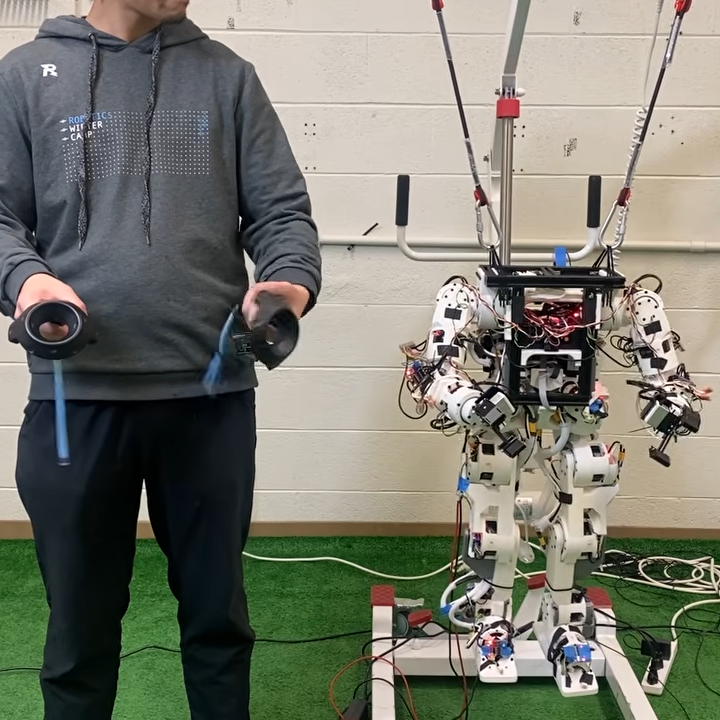
Humanoid robots, even scaled-down ones, tend to be expensive. The Berkeley Humanoid Lite offers a more accessible and economical option by centering the design around 3D printed actuators that make up the bulk of the robot’s frame.

The actuators are made by combining motors with printed cycloidal gearboxes and an embedded magnetic encoder. They’re modular, so even if one has no desire to recreate the whole robot it might be worth checking out the actuator design details to see if they might be useful in some other way.

The Berkeley Humanoid Lite isn’t a finished product so much as an open-source, easily customized reference design. The GitHub repository contains everything one might need, and you can watch some basic demonstrations, including VR-driven teleoperation, in the video embedded below.

At a total hardware cost of under $5,000 USD it’s still expensive, but much more economical than other humanoid robots, open-source or not. As mentioned, even if one doesn’t plan to build one, the modular actuator design is worth keeping in mind for other purposes.

This Library Needs to Be At Least… Three Times Bigger

28 August 2026 at 22:00

Many of us have noted a tremendous price increase in many computer components for some mysterious reason. Whatever this cause is will be debated among the various modern philosophers and Diogeneses, but regardless of cause we all still have to live in this world and make do. That turns us towards getting maximum value from the things we already have rather than trying to go out and buy more computer components right now, like [svofski] using his vast swath of existing microSD cards to build an SD card library.

The library is based around a tiny robotic arm that can physically grip the cards and move them in and out of a reader. The first iteration of the arm involved rotating the two pincers, but this turned out to be overly complicated and [svofski] eventually settled on a design resembling a rack and pinion that slides the two pincers together instead. With the gripper sorted out, it’s placed in system called T-bot arrangement, similar to coreXY kinematics, that lets it pick and place among 12 microSD card slots.

Many of the parts in this build were directly from or inspired by 3D printers, making it relatively simple with so many parts available. [svofski] didn’t build it for a specific use case, though; mostly it was constructed out of fascination for robotic tape changers which perform a similar function. But for anyone who actually needs to duplicate a large number of SD cards, or other types of removable media, this could prove to be a fairly handy robot.

Report: Amazon eyes ‘fully automated’ delivery stations to bring robotics to the last mile

25 August 2026 at 12:53
Amazon’s ZancaSort system brings packages to workers automatically at its Last Mile Innovation Center in Dortmund, Germany. A separate initiative, Project Tetromino, reportedly aims to bring full automation to delivery stations. (Amazon Photo)

Visiting an Amazon delivery station can feel like walking into the past.

While many of its massive fulfillment centers are equipped with the latest robots and automation, Amazon’s delivery stations — the final stop before packages reach the doorstep — remain mostly manual. Workers often sort parcels by hand, load them into bags, and stage them for drivers.

That could be changing. Business Insider reports that Amazon is developing an internal initiative called Project Tetromino to build “fully automated” delivery stations, citing an internal planning document that includes specific financial projections.

The name appears to be a nod to Tetris, reflecting the puzzle-like challenge of efficiently organizing packages for delivery vehicles.

“We’re always exploring and testing new technologies across our operations to improve safety and the delivery experience for customers,” Amazon spokesperson Brad Glasser said in a statement. He added, “The details cited here are inaccurate and don’t reflect our current plans. Like any early-stage concept, this is one of many initiatives we regularly evaluate, and plans evolve significantly as we learn.”

Business Insider reported that a key technology behind the effort could come from Boxbot, an Alameda, Calif.-based robotics startup that uses conveyors and AI-driven storage trays to automatically sequence packages for vehicle loading. The company says the process is up to 10 times faster than manual methods.

Boxbot has raised $29.5 million from investors including Toyota Ventures, Playground Global, and Maersk Growth.

Responding to an inquiry from GeekWire, Boxbot CEO Austin Oehlerking said he could not comment on activities with any specific customer but said the company has “tested and deployed live systems within the parcel delivery, logistics, and automotive industries over the last several years.”

Oehlerking described Boxbot’s technology as filling a gap in warehouse automation. Automated storage and retrieval systems are typically designed for fulfillment operations, while Boxbot is building them for high-throughput package handling at other points in the supply chain.

“This type of storage system can be very useful at different points in the supply chain, depending on the customer,” he added.

Amazon said its delivery station initiatives are “designed to complement and empower our workforce.” The company has been ramping up automation across its operations, with more than a million robots now deployed in its fulfillment network and plans to more than double its fleet of robotic arms this year, citing goals to improve safety, ergonomics and efficiency.

The company has also opened a Last Mile Innovation Center in Germany, where it has been testing delivery station technologies including automated unloading, sorting, and scanning systems.

Startup Spotlight: Tech consultant returns to the farm with Reroot, connecting growers with consumers

18 August 2026 at 18:46
Reroot founder Genevieve Priebe, a fourth-generation member of a Montana farm family. (Photos courtesy of Genevieve Priebe)

Genevieve Priebe took a business meeting this summer while bottle-feeding baby goats. A couple of years ago, she was advising executives at some of Seattle’s largest tech companies.

“Best decision I’ve ever made,” she said of her career change.

Priebe is the solo entrepreneur behind Reroot, a bootstrapped Seattle startup trying to make local food as easy to find and buy as anything else online.

Genevieve Priebe, founder of Reroot.

The company operates a marketplace where independent farmers, ranchers, bakers and makers sell direct to customers, currently live with founding partners in the Pacific Northwest. In July it launched a free companion app, Reroot: Find Local Food, that maps more than 50,000 producers across the U.S. and parts of Canada.

She has also built a patent-pending tool called Walk & Talk, which lets a farmer update an online store by voice while walking the field, with or without a cell signal. When they’re back in range, it reconciles what they said against any sales that came in while they were offline.

A fourth-generation farm kid from Whitefish, Mont., Priebe grew up driving her dad’s tractor before she could reach the pedals and counting change at farmers markets for her mom, a flower farmer. She left for college and spent two decades in Seattle consulting, starting at Accenture and working for clients including Microsoft, T-Mobile, Starbucks and Boeing.

After her parents passed away, she and her brother took over the family farm. Priebe ran the numbers on what it takes to make a living growing food, and found it “close to impossible.” That’s a big part of what she’s now looking to solve as a startup founder.

“I didn’t want to be a founder,” she said, “but I couldn’t walk away from the problem.”

Continue reading for Priebe’s answers to our Startup Spotlight questionnaire.

In 50 words or less, give us your startup’s elevator pitch?

Local food is all around you, but finding it is hard. Buying it directly from the source is even harder. Reroot exists to fix that. We’re a discovery app and marketplace that connects independent producers to the people who love what they grow, raise and make.

What problem are you obsessed with solving?

Something that perhaps most people wouldn’t see as a problem. That is: why is it easier to buy a mango from Peru than a tomato from a farm 10 miles away?

What surprised you after talking to customers?

My biggest surprise was that most small farms pay to be farmers. They don’t make money, they lose money. Less than 50% of the 1.9M farms in the US are profitable. Average median farm income is over a thousand dollars in the red. It’s no surprise that 15,000 farms go out of business every year and unfortunately the story isn’t much better for other independent food producers. Growing our food is one of the most important jobs, yet it’s close to impossible to make a living doing it.

How has AI changed the way you build your company?

Dramatically. Two years ago, I’d have needed a 5-person development team, 18 months, and $1.5M to do what I’ve done solo in about four months. Traditional development cannot compare to the speed with which AI has enabled me to operate.

I do have a strong tech background, but haven’t written a single line of code and yet I’m live with a fully functioning marketplace that processes financial transactions, integrates with Square and Stripe, has sent over 100,000 marketing emails for our customers, manages inventory, fulfillment, and analytics. And, bonus — we just launched a free discovery app called Reroot: Find Local Food that maps 50,000+ local food producers in the US and parts of Canada.

What’s one thing people misunderstand about your startup?

In a world of AI-powered, niche, technology businesses, people seem surprised at how simple the idea is. They assume it already exists. It doesn’t. There is no single place to discover, follow, and buy from local producers. That gap is exactly why I built Reroot.

What’s the toughest decision you’ve made in the past year?

Every advisor and investor I’ve talked to has told me to find a technical co-founder, and even better if he’s younger and male. The decision to ignore that advice and bootstrap solo as a woman in my forties was simultaneously the hardest decision I’ve made and the easiest. I’m choosing a different path than raise-and-burn: heads-down building for real customers who need what I’m making. It’s working.

What’s the one piece of advice you give to other entrepreneurs?

Don’t overthink it. I spent decades in environments where every decision needed a PowerPoint deck and three rounds of approvals. The best thing I’ve done as a founder is just move: build it, ship it, learn, repeat.

We’ll know our company has made it when…

When the hardest part of farming is no longer the marketing. When farmers like my parents, grandparents, and great grandparents can actually afford to do the work that they love. And when I can conveniently replace most of my grocery store spend with local food purchased directly from my favorite producers.

❌
❌