❌

Normal view

There are new articles available, click to refresh the page.
Yesterday β€” 28 October 2026Tech

Hacking the Modern Tamagotchi With UART

28 October 2026 at 19:00

Although not technically the first virtual pet, the Tamagotchi handhelds certainly popularized the idea and made it a worldwide phenomenon. In the late 90s it was hard to go out in public and not see them dangling from backpacks and belt loops. They turned out to be more than a passing fad, too. There have been Tamagotchis in various forms since then, and one of the latest, the Tamagotchi Paradise, is uniquely hackable thanks to this custom UART interface.

The build starts with a simple and inexpensive CH340G UART adapter with a built-in USB interface. A custom 3D printed enclosure is used to house the adapter and also help to expose the interface to the Tamagotchi. This is done by wiring three pins to nickel strips, which are threaded through slits in the case and looped back around to create a pogo-style adapter for the Tamagotchi’s custom dock. Normally this would be used to link to other Tamagotchis, but in this case the USB-to-UART adapter mimics it, allowing for all kinds of in-game shenanigans. The project’s creator [Squalius] shows it off by connecting it directly to a browser tool in Google Chrome.

Not only that, but this can also be used to modify the software running on the handheld entirely, with the video showing demos playing not onlyΒ Super Mario but alsoΒ DOOMΒ (of course). This isn’t too surprising given that these games are built with modern 32-bit ARM microcontrollers. For the 90s purists, though, it probably won’t surprise anyone to know that these devices have been the subject of various hacks almost since they came out.
Before yesterdayTech

Arc Browser Shutdown: What Users Need to Know Before Dec. 22

23 October 2026 at 14:23

Arc stops working on Mac and Windows Dec. 22, 2026. Learn how to export tabs, transfer your data, and prepare for changes to Arc Search on mobile devices.

The post Arc Browser Shutdown: What Users Need to Know Before Dec. 22 appeared first on TechRepublic.

KiCad… In The Browser?

22 October 2026 at 11:30

KiCad is a useful tool for designing printed circuit boards, but it’s of no use to you if you can’t install it on the computer you’re on. To get around that, [Akshay Rukade] has whipped up a browser-based alternative to help keep you working in less permissive environments. It’s called ZiroEDA.

Quite simply, ZiroEDA is a TypeScript port of KiCad 10.0.6’s C++ source code. You get the schematic editor, the PCB editor, the interactive router, and the electrical and design rule checkers all running in a browser. It can open .kicad_pro files as you’d expect, and you can edit and save them as you would if you were working in standard KiCad directly.

[Akshay] reports that KiCad’s own kicad-cli was used for compatibility testing, and that zone fills came out vertex-identical from ZiroEDA versus using KiCad itself. With that said, the project is still a work in progress, and some dialogs from the original software are still missing. Projects are said to be end-to-end encrypted, but you’ll hopefully lose your job quickly if you try and put anything important to national security through a tool like this. You can always try it, just to give your higher-ups a heart attack.

Source is available on GitHub if you want to see how it all ticks. We’ve featured other great KiCad hacks before, too, like this GPU-accelerated autorouter. If you’re working on PCB tools of your own, don’t hesitate to notify the tipsline.

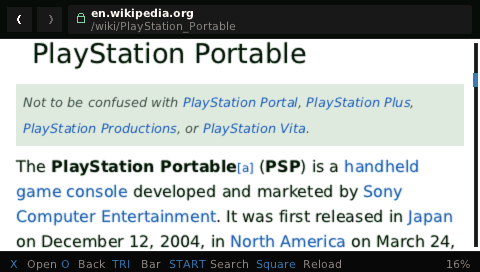
A Modern Browser for the PlayStation Portable

13 October 2026 at 07:00

The Sony PlayStation Portable, better known as the PSP, is now over two decades old. In its day it was an impressive handheld gaming machine, not least because of the inclusion of wireless networking and a web browser.

We tried the browser back then, and it’s fair to say the experience was a little underwhelming. We’re thus mightily impressed at [Steve Janovitz], who has produced Tilefinch β€” Β a modern web browser for the PSP.

Depending on the model, the PSP came with a 333 MHz MIPS32 processor, and for all but the first model, 64 MB of RAM. Powerful back in 2004,but leagues behind something that would run any modern web browser. So how’s he doing it? The answer seems to be by careful choice of software components and use of the PSP’s built-in capabilities for jobs such as video decoding. The browser engine is Lexbor for example, while JavaScript is handled by QuickJS.

We don’t have a PSP to hand so we can’t tell how it would render Hackaday or even how fast it is, but we’re suitably impressed by this project. For PSP enthusiasts it’s a game-changing browser, but for us it also points the way towards web browsing being a possibility for other platforms. As the distinction between a high-end microcontroller and a low-end SoC becomes blurred, we’re starting to see exciting new hardware emerging with devices such as Espressif’s ESP32-P4 that, on paper at least, might be capable of running this browser. Exciting times in limited hardware web browsing might be upon us.

❌
❌